
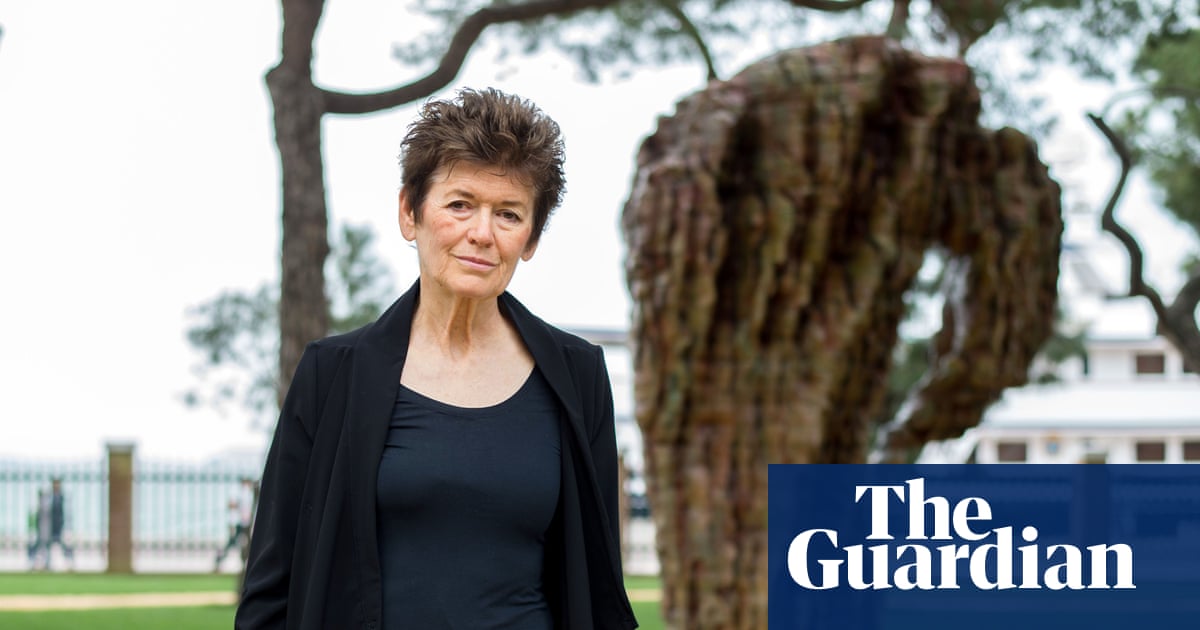
Sculptor whose large, complex works were often constructed from cedar beams
In August 1997, what looked like a rocky outcrop suddenly appeared on a hillside above Wakefield. This, it turned out, was not geology but art: a piece called ence pence by the American sculptor, Ursula von Rydingsvard, who has died aged 84. She had a second, bigger show at the Yorkshire Sculpture Park in 2014.
Like most of Von Rydingsvard’s work, ence pence was large: two metres high and wide by five metres long. For all its stone-like appearance, it was made of wood. “Being big doesn’t mean being invulnerable,” Von Rydingsvard said.
Looking like stone while being constructed from wood was only one of ence pence’s paradoxes. When Von Rydingsvard was doing an MFA in sculpture at New York’s Columbia University in the early 1970s, American art was in thrall to minimalism. The young student was not a fan. “The work was so clean!” she said in an interview in Studio International in 2013. “All those intellectuals, clean, clean! Nothing felt gritty or sexy.”
In the footsteps of Donald Judd, the master minimalist, Von Rydingsvard had tried working in steel, winding cloth through holes she drilled in sheet metal in an effort to soften the material’s rigidity. The results did not please her. It was only when a fellow student, a Scottish monk, brought her an armful of four-by-four cedar beams that she found a way forward.
“Of course, we didn’t have any woodworking facilities at Columbia,” Von Rydingsvard recalled in an interview with the online art magazine, Curator.site, in 2019. “We had a room to work in steel. The moment my circular saw hit the wood, I was like: ‘Oh, my god.’ The cedar itself felt soft. It felt like the colour of skin.” Milled cedar and the circular saw would be mainstays of her art for the next 50 years.
Wood may have had more than a sensuous charge. For all her German surname and birth, she was the fifth of seven children of Ignacy Karoliszy, a Ukrainian farmer, and his Polish wife, Kunegunda (nee Sternal). When their daughter was born in 1942, Ignacy had been coopted as a forced labourer by the Nazis. At the end of the second world war, he and his family were moved around Europe from one displaced persons’ camp to another. After the eighth, in 1950, they were finally allowed to emigrate to the United States, settling in the small working-class town of Plainville, Connecticut. Ignacy worked in a factory, Kunegunda as a waitress. “There was no such thing as an artist in Plainville,” Von Rydingsvard later remarked.
One continuity through all this had been wood. “I come from a long line of Polish peasant farmers,” the artist said. “They were surrounded with wood – wooden homes, wooden fences, wooden tools to farm the land.” In the camps, she had slept on wooden bunks. Wood had meant survival, as she told the Boston Globe in 2011. Her mother had hung a wooden spoon around her neck with string so that she would always have something to eat with if food appeared.
Not just the material but its habitual forms recurred in her art. In particular, Von Rydingsvard returned to the bowl, notably in her 1996 work, Ocean Floor – a boat-sized cedar dish with 50 pendulous sacks made from dried cows’ intestines hung from its rim.
With its echoes of Louise Bourgeois, Ocean Floor conflates hunger and salvation. It is also both abstract and not, as was true of most of Von Rydingsvard’s art. The fact that her work contained elements that seemed recognisable did her no favours in a day of minimalism. “If you made work with a figure, you’d be dead in the water,” she recalled. Her first decade after Columbia was marked by a rejection she might not have known had her sculpture been less formally suggestive.
Her break came in 1988 when she was given an exhibition at Exit Art, a gallery specialising in the work of under shown artists. Reviews were uniformly enthusiastic, propelling Von Rydingsvard overnight into the sculptural elect. After leaving Columbia, she had made ends meet by teaching, since 1982 as an assistant professor at Yale. Now she was able to make art full time.
Over the next four decades, her work would be acquired by, among others, the Whitney and Metropolitan Museums and the Museum of Modern Art in New York, and the Walker Art Centre in Minneapolis. It also entered such blue-chip private collections as Microsoft’s in Washington state.
If Von Rydingsvard had earlier been dismissed as anti-minimalist, this had never been entirely the case. Building her work from the floor up out of stacked cedar beams, she would finally take her saw to them to cut them into shape. If the resultant forms were evocative and organic, the square ends of the cut beams still showed through them. The spoons and bowls were braced by an armature that looked very like that most modernist of things, the grid. This tension underpinned her best works, such as ence pence and Bronze Bowl with Lace (2013-14). “The grid is my guardian,” she said.
At Yale, she had met and married her second husband, the Nobel prizewinning neuroscientist Paul Greengard. Her first husband, a doctor called Milton von Rydingsvard, had been a high-school sweetheart in Plainville. Marrying him, she followed him around his various medical residencies, lastly to Oakland in California. In 1973, after the birth of their daughter, also called Ursula and known as Ursie, the couple divorced.
Greengard died in 2019, Ursie in 2022. Ursula is survived by her three grandchildren.