Administration had waged aggressive bid to sow doubt about midterms results but worst fears were not realized
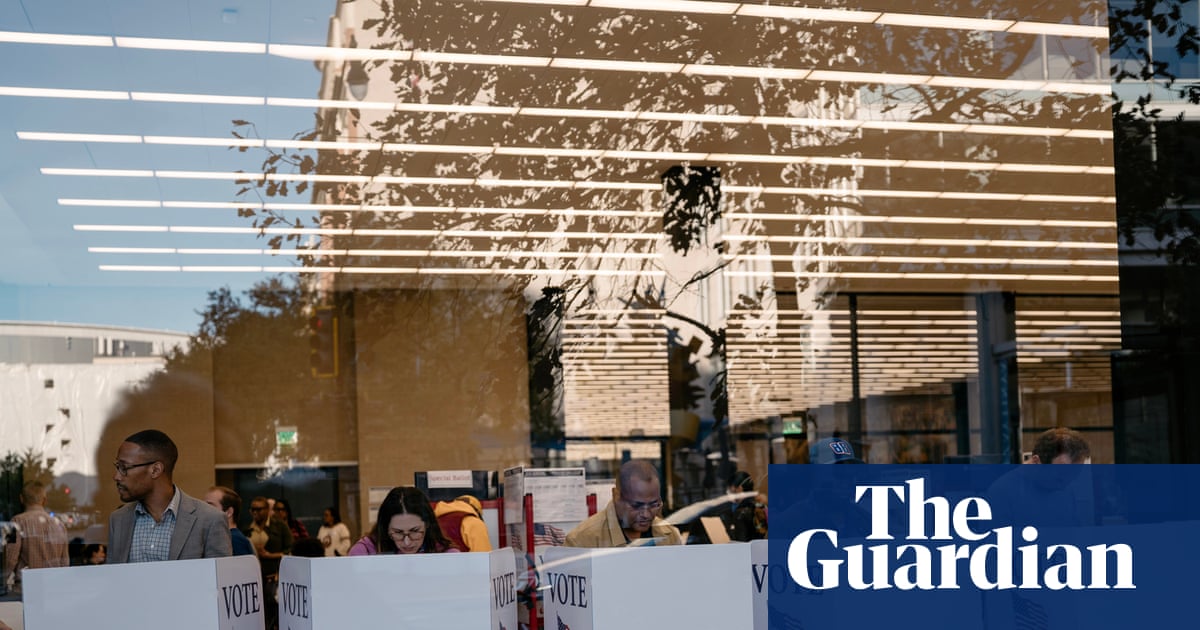
In the months leading up to the midterm elections, Donald Trump’s administration waged an aggressive effort to sow doubt about the results, intimidate voters and election officials, and signal they would use the power of the federal government to challenge the electoral process.
But when the results came in Tuesday night, revealing a massive blowout for the GOP, Trump did something almost unprecedented: he accepted the results. Trump said he was “absolutely willing” to accept the outcome and looked forward to working with Democrats. With the exception of the 2024 election, which he won and Republicans performed well in, Trump has raised doubt about every presidential race and midterm since his first election in 2016.
Perhaps he had no choice. “It was essentially too big to rig,” an unnamed Trump adviser told CNN. But even before the results were known, many of Trump’s election interference attempts simply never materialized.
Administration officials had declined to rule out the possibility of deploying immigration agents to the polls. There were worries that the 1,000 justice department monitors deployed to voting sites would attempt to meaningfully disrupt the voting process. Some thought Trump would try something outlandish like trying to seize voting machines or ballots. Others speculated Republicans could try a longshot maneuver to block new members of Congress from being seated on January 3.
None of that happened, and the certification of new members in January looks like it will go smoothly.
That’s not to say Trump and his allies fully respected the electoral process. The administration’s legal efforts in that regard are ongoing, and presumably won’t stop. In a serious escalation in the campaign’s final weeks, the justice department attempted to block certification of the Alaska Senate race and California election officials from counting certain ballots. It has also threatened to prosecute California election officials, serving them subpoenas on Monday, the day before election day. There’s no immediate sign the administration will cease those efforts.
Cleta Mitchell, a Republican lawyer who has been a key player in spreading doubt about American elections, fumed at Senate majority leader John Thune for not passing a sweeping voting restriction bill.
“It’s not a big deal to you that our election system has been taken over and manipulated by the left. That aliens by the hundreds of thousands are on our voter rolls, that there are illegal votes by the thousands in the election results…and that it matters,” she said in a post on X.
“When election results are not close … no one looks under the hood,” she said on another post.
On Tuesday, there were isolated problems at the polls that Trump allies tried to spin into major controversies. “This is how the left steals elections,” Katie Miller, the wife of top Trump aide Stephen Miller, posted as there were problems with tabulators in a competitive congressional race in New York.
But that effort wasn’t carried forth by the Republican loser of that race, representative Mike Lawler, who publicly to assure voters that there were no shenanigans with the vote and later quickly conceded last night.
“There’s no question that part of the reason the election subversion scenarios didn’t come to pass was because the margins of victory rendered them futile,” said Sean Morales-Doyle, a voting rights lawyer at the Brennan Center for Justice. “But I think it had more to do with the incredible work of pro-democracy forces in foreseeing, preparing for, and responding to the administration’s efforts for the last two years.”
To some experts, Tuesday felt like a shift in Trumpworld’s approach to election integrity. “I don’t know necessarily margin of victory makes much difference to those who have profited off of the economy of grift around election conspiracies for quite some time. It might be the politics overall in the nation have changed to some degree, and that creates a different incentive structure,” said David Becker, the executive director for the Center for Innovation and Research.
For months, Democratic attorneys general and others war-gamed possible scenarios of what they would do if Trump tried to contest the results or took the extraordinary step of trying to use armed force to intimidate voters. When the justice department began filing lawsuits in the election’s final days, lawyers were prepared to rush to court.
Democratic gains at the state level also positioned the party to defend against election interference in the 2028 presidential election. Democrats held on to secretary of state offices, which oversee elections, in the swing states of Arizona, Nevada, and Michigan. They also picked up secretary of state offices in Georgia, a major battleground, and Ohio.
They also picked up hundreds of legislative seats, claiming a trifecta – complete control of state government in Wisconsin, Michigan, Minnesota, Pennsylvania and Arizona. Control of those positions will allow Democrats to pass laws to prevent against meddling in the certification process.
“We should not walk away from 2026 feeling as if the mobilization against the forces of anti-democracy was overkill or unnecessary,” Richard Hasen, an election law professor at the University of California, Los Angeles wrote in an essay for Slate.
“We should be proud that, thanks to the efforts of thousands of people, the system held against a powerful barrage.”