A small island community spent years preparing for the climate crisis. Now they have no water – and nowhere else to go
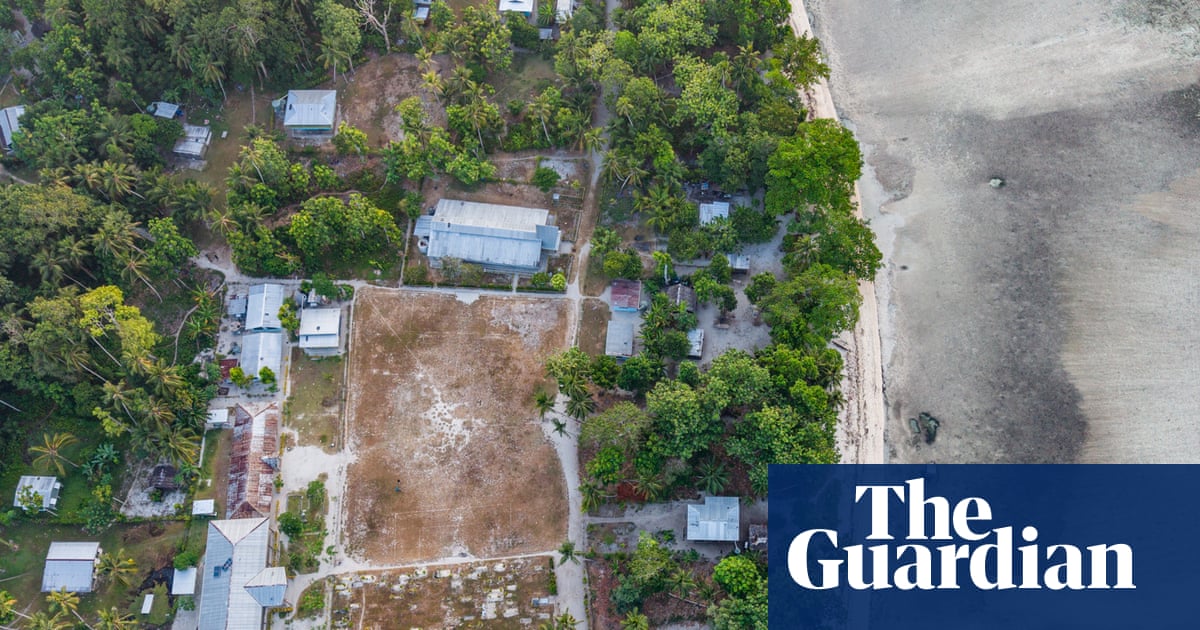
Visitors are few to the island of Ahus, a tiny atoll in the north of Papua New Guinea’s sprawling archipelago.
But Prof Josh Cinner and his team are well known. The ocean sustainability researchers have been visiting the island for a quarter of a century, their arrivals usually heralded with a modest ceremony, dancing and shared food and drink.
The last time they arrived – in October – it was “a ghost town”.
“The research team wondered if everyone was off-island,” Cinner, director of the University of Sydney’s Thriving Oceans Research Hub, tells the Guardian, “but then they would look in the houses and just see people lying on the ground of their huts, trying to conserve energy, trying to conserve water.
“School was cut to a half day … because it was too hot for the kids to be in school, and there’s been a massive reduction in fishing. Fishing is very physical, and people just don’t have enough water, they don’t have enough energy, and it’s just too hot to go fishing.”
PNG, and a huge swathe of south-east Asia, is in the grip of a brutal “supercharged” El Niño event, that has brought soaring temperatures, vanishingly little rain and widespread food and water shortages.
The drought has meant that on the neighbouring, larger island of Manus, there is little food on sale at the markets. But the fishers of Ahus have few fish to trade anyway.
The intensely interconnected economy which has sustained these islands for generations is breaking down.
“When it finally did rain, everyone was excited,” Cinner says. “But there’s all this smoke from the bushfires in Borneo, it’s just haze. So when the rain came, it was acid rain.”
Sign up for a weekly email featuring our best reads
Instead of harvesting the water, villagers in Ahus were forced to hurriedly disconnect their catchment systems, so as not to poison what little drinking water they did have.
“What could prepare you for this? Even the rain in a drought is toxic,” Cinner says. “What do you do? The wells are dry. They have to paddle across the channel to try to get water on the mainland [Manus Island], but they don’t have rights to the water there. And the creeks there are drying out.”
‘They have nowhere to go’
Ahus is on the frontline of the climate crisis. It is not a theoretical risk, a line in a government report or a future technical issue to be addressed, but a clear and current existential threat.
The community, tightly bound by custom and history to the land and waters of the island, may not survive. In a country where 97% of land is customarily held, options for relocation are few.
They knew climate change was coming, and would affect their fishing-dependent livelihoods and lifestyle. For years, they have welcomed visits from the United Nations Development Program and the National Climate Change and Development Authority and worked with the World Wildlife Fund and the Nature Conservancy to diversify livelihoods.
“This is a place with a plan,” Cinner says. “But even though they’ve been working for decades to prepare, nothing could have prepared them for what’s happening right now.”
In the researchers’ most recent survey, taken last month, just 7% of households had enough water to drink and 81% reported being unable to cope with climate change.
The emergency carries a deep injustice. The people of Ahus Island are among those on Earth who have contributed least to climate change, yet they are bearing its brunt first, and most acutely. They also have the fewest options to combat it.
“They’ve got nowhere to go. They can’t do anything. There’s nowhere to go and there’s not much left to do. And it’s deeply unfair,” Cinner says.
On Ahus Island, Michelle Suri says there is not enough clean water – “to drink from wells you have to force yourself to drink due to heat and thirst” – and almost every household is going hungry.
“Food is scarce,” Suri says.
“Most people fish less [and] glean less due to heat and shortage of drinking water, which results in most households facing poverty and hunger. Most household activities have been reduced due to heat … most people lie on the floor of their homes or on beaches to stay cool and preserve energy. Some had to be in the sea for hours during the daytime to stay cool.”
Suri says the community has spent years preparing for the growing effects of climate change – building sea walls and installing water tanks – but the sudden, severe impact had shattered the community’s faith in their ability to withstand the rising seas and worsening climate.
“The drought has been very bad for us. You can literally tell that everyone’s wellbeing and health was very much affected.”
Fighting for the Pacific?
Far away, in Antalya, Turkey, tens of thousands of climate scientists, policy advocates and government leaders have gathered for the 31st Conference of the Parties, the UN’s annual global climate summit, which concludes on 20 November.
Speaking from Australia, Cinner recognises the critical importance of the Cop talks, but sees a disconnect between Australia’s rhetoric on climate – and its co-presidency of these Cop talks – with its actions.
“This is what I think of as policy incoherence: we have policies against climate change but we’re also subsidising the fossil fuel industry at an amazing rate and opening new fossil fuel projects. I think the government is finding that other governments are seeing through that, and I wish they would as well.”
The Australian prime minister, Anthony Albanese, told the conference Australia was “proud to be a leader on climate action … proud to be here fighting for the interests of our Pacific family”.
But the UN secretary general António Guterres, in his address, said “the brutal truth is that the climate crisis is outrunning us”.
“Fossil fuels must go the way of the dinosaurs. But that won’t happen on its own.
“The dinosaurs did not have a lobby. But fossil fuels do.”