
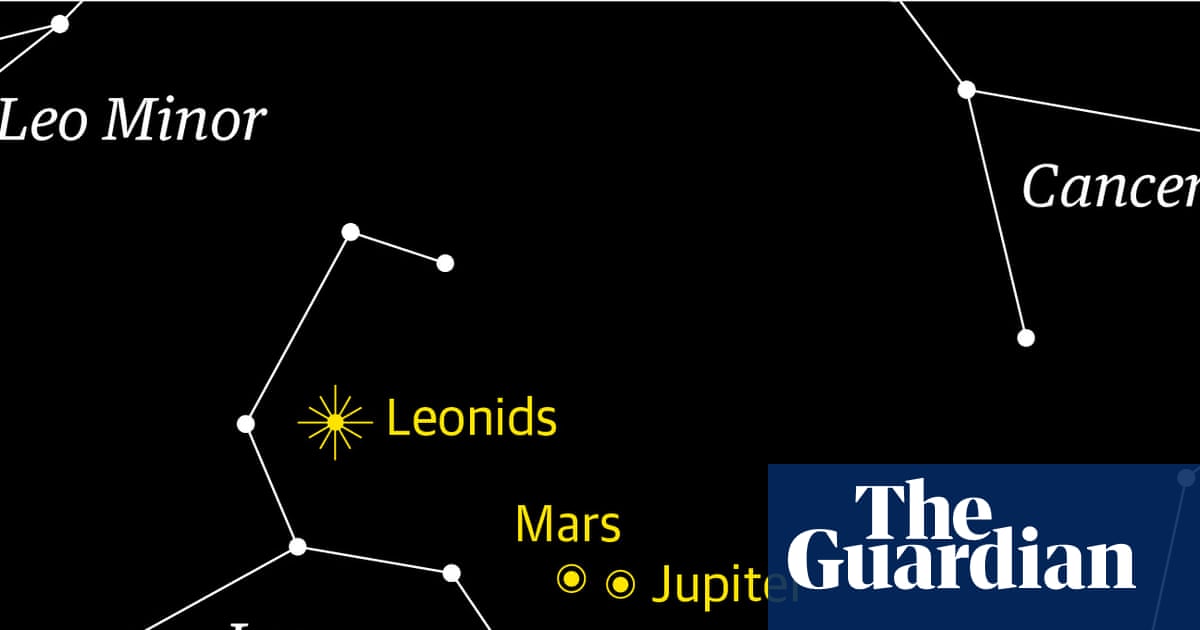
Annual display appears to radiate from constellation of Leo in eastern sky as Earth passes through comet debris stream
The annual Leonid meteor shower reaches its peak this week, offering a chance to count meteors. The shower is expected to be at its most active during the night of 17–18 November. Under ideal conditions, observers may see up to 10–15 meteors an hour.
What they lack in numbers, they make up for in brilliance.
The Leonids are produced by dust shed by comet 55P/Tempel-Tuttle, which orbits the Sun every 33 years. As Earth passes through this debris stream, the particles strike our atmosphere at about 71 km/s, making them among the fastest meteors of any annual shower. As a result, they often leave bright, fleeting streaks across the sky.
The meteors appear to radiate from the constellation of Leo, the lion, which rises in the east after midnight. The chart shows the view looking east from London at midnight on 17–18 November.
Conditions will improve towards dawn as Leo climbs higher in the sky. As an added reward for your efforts, Mars and Jupiter will form a beautiful pair just in front of Leo’s chest.
From the southern hemisphere, Leo remains relatively low in the northern sky, making the hours before dawn the best time to look for meteors.


