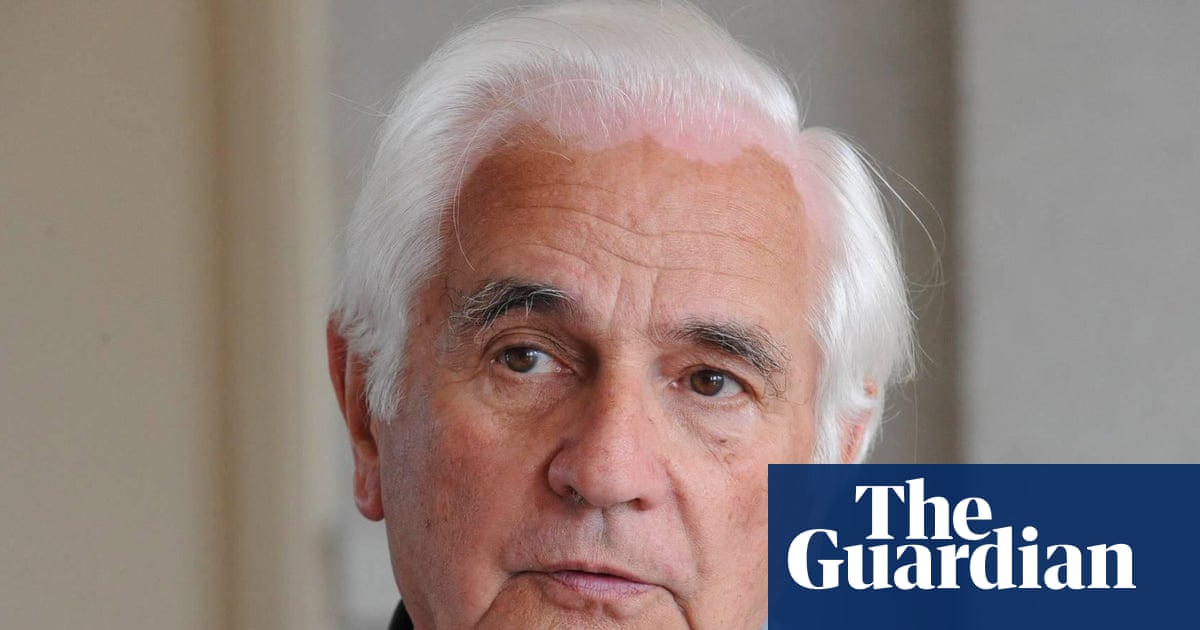
French conscript in the Algerian war of independence who documented abuse by the colonial forces and became an anti-war activist
On a cold night in January 1956, Stanislas Hutin, a reluctant 25-year-old conscript to the French army posted to the mountains of northern Algeria, heard screams he thought were from a pig having its throat cut. The following morning he discovered it was the sound of a 14-year-old shepherd boy who had been wired up to his military unit’s field generator and tortured with electric shocks. “They ran him through the gégène [an electric shock device] … this morning I am completely broken,” he wrote the next day.
Hutin, who has died aged 95, was horrified by what he saw during his six months between 1955 and 1956 in the French colony, where a war for independence had been raging for a year. His father, a former member of the French resistance, had urged him to “bear witness” and so he did; jotting everything down in a red spiral notebook. He noted the savage beatings, the torture, the summary killings carried out by French forces that he saw or that comrades recounted.
He also noted the brutalisation of fellow soldiers, who were initially angry and opposed to crushing Algerian independence, but whose fear made them view the local population as a less than human enemy. In one letter to his brother, he wrote: “I feel like I’m living though exactly what we went through during the resistance in 1943 and 1944, but in reverse. I’m doing – we’re doing – what the Krauts did.”
After his return to France, Hutin’s account of the torture and abuse by French forces was published anonymously, provoking a political and moral debate. It also blew apart the government and the military’s claim that France was not engaged in a war but was on a “pacification” operation to restore law and order among the local population.
Born in Rennes in western France, Stanislas was the third of the five sons of Paul Hutin-Desgrées, a well known Breton Christian democrat and co-founder of the daily newspaper Ouest-France, and Magdeleine Desgrées du Loû, the daughter of a Brittany family whose noble lineage dated back to the 14th century and whose name her husband had added to his own on their marriage. In 1954, aged 24, Hutin was training for the priesthood in a Jesuit seminary when he was called up to do his military service in Madagascar. On his return to France, he was informed that his national service was being extended and he would be sent as a recalled reservist to north Africa.
Hutin considered refusing and asked his father whether this would constitute desertion. “My father told me: ‘You’ll be much more useful on the ground among the men; if you desert nobody will listen to you. As a seminarian you have a duty to speak out and to live out your faith. You must bear witness,’” Hutin recounted later.
Posted to the 21st Colonial Infantry Regiment as a machine gunner, Hutin and the young troops around him, aged 19 or 20, were angry and reluctant conscripts. Sent to Constantine, in north-east Algeria, they were at first horrified at the way locals were being treated. “We were taken to a huge farm with what looked like rabbit cages. We discovered that these cages housed the farm’s Arab workers. This marked a new shift in my comrades’ attitudes. They were farm workers – from Brittany, Alsace – and they were outraged by the appalling way these people were being treated,” he wrote.
When his unit was posted further south to Aurès in the Saharan Atlas mountain range, he noted a change of attitude among the unit, describing an “animosity – which sometimes turned into hatred”, as the French troops were ambushed and harassed by local fighters, the fellagha.
His objection to the torture of the 14-year-old boy, Saïd Boutout, put Hutin in opposition to his unit’s commander, “a brute, a sadist”, who labelled Hutin a communist, and his comrades, who called him the curé [the parish priest].
“I got into a fight with my lieutenant, who had witnessed the torture. I don’t know if he was the one operating the machine … I almost punched him in the face. I yelled at him … that night put me at odds with the chain of command for good,” Hutin wrote.
Of fellow soldiers, he noted: “I’d tell them, you can easily avoid all this beating of prisoners, torturing them, forced labour, executing prisoners without trial, you can rebel. You won’t be prosecuted. It’s them, the officers, who can be dragged before the courts.”
Instead of manning the machine gun, Hutin was allowed pacifist duties, teaching the ragged local children basic maths and history.
After his return to France in 1956, excerpts from Hutin’s diary were published anonymously by the French priest and intellectual Father Robert Seillon in an article titled The Algerian War and Christian Conscience in the Jesuit newspaper L’Action Populaire, and republished in several pamphlets. His account encouraged those opposed to the war, and sparked a moral and political crisis in France, where the French government and military accused their critics of anti-French propaganda and demoralising the army. The war that had started in 1954 ended in 1962 in a humiliating defeat for France and in Algerian independence.
Hutin served for only six months in Algeria, but the experience scarred him. He renounced his plans to join the priesthood and spent decades working on development projects in Africa. His journal was widely cited by historians, but was not published in its entirety until 2003. His photograph of Boutout in his torn sweater became a defining image of the war. In 2013 Hutin tracked down Boutout and they had an emotional reunion in Algeria.
In 2004, Hutin joined the Association of Former Conscripts in Algeria and Their Friends Against the War (4ACG), a group made up of veterans who donate their war pensions to NGOs working in the former north African colony to promote “reconciliation”. He later admitted: “I don’t really like the term ‘reconciliation’, because I’ve never needed to reconcile with the Algerians. I’ve never been at odds with them.”
Hutin is survived by a brother, Gonzague.