
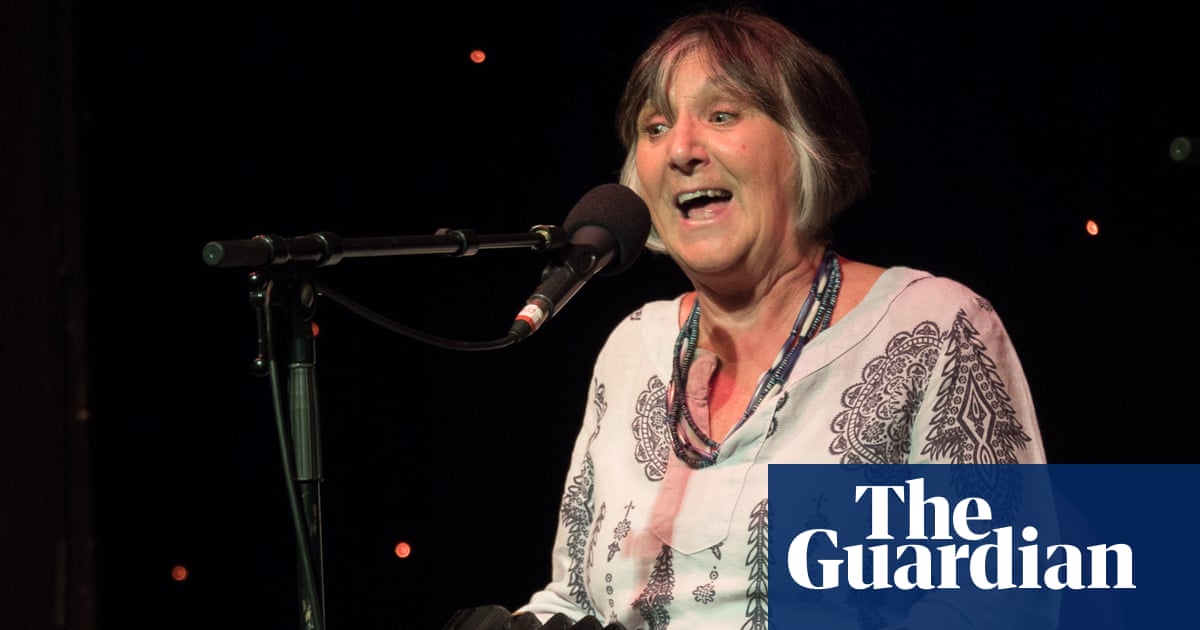
Folk singer, songwriter and co-creator of the music for the popular children’s TV series Bagpuss
The folk singer, songwriter and broadcaster Sandra Kerr, who has died aged 84 of leukaemia, was strongly influenced in her early years by Ewan MacColl and Peggy Seeger. In the 1960s she sang and recorded albums with her husband John Faulkner, and together they created the music for the popular 1974 children’s television series Bagpuss.
The couple had already composed music for Sam on Boffs’ Island, a schools television series written by Michael Rosen, starring Tony Robinson and Miriam Margolyes, that was broadcast in 1972. Oliver Postgate and Peter Firmin had provided stop-motion animated sequences for that series, and when they were devising Bagpuss, they turned to Sandra and John.
Postgate suggested the song themes, and Sandra and John added lyrics and traditional tunes, accompanying themselves for the filming on concertina, dulcimer and autoharp. Sandra was the voice of Madeleine the Rag Doll, and John was Gabriel the Toad.
Though only 13 episodes were broadcast in 1974, with frequent repeats the stories and the music became familiar to generations of children. In 1999 Bagpuss was voted the best-loved children’s programme of all time.
This prompted an album of new recordings of the songs by Sandra and John. With Sandra’s daughter, Nancy Kerr, and son-in-law, James Fagan, they also devised a concert show of the songs; audiences of adults reliving their childhood often greatly outnumbered the children.
Born in Plaistow, Essex, Sandra grew up in the East End of London, where her father, Roderick, worked on the docks, and her mother, Violet (nee Skipper), in a sweet factory. Sandra described a family life rich with music, singing and literature.
At Plaistow grammar school, there was music from jazz to opera and Sandra started an all-girls’ skiffle group. After school, she trained as a nurse and later as a teacher.
While still a teenager, Sandra was introduced to folk music at the Singers’ Club, based in trade union premises in Soho Square, in central London, where the resident singers were MacColl, Seeger and Bert Lloyd. She was captivated. There she met Faulkner and they started singing together and later, in 1964, were married. Before then, Sandra moved in with MacColl and Seeger and, in exchange for childcare, they gave her one-to-one classes in folk music, balladry, vocal techniques and music notation.
MacColl then extended these classes to a select group of young singers, including Sandra and John, known as the Critics Group. The unfortunate name was intended to describe self-criticism, but the wider folk scene assumed that they were criticising others. The Critics released albums on the Argo label, with Sandra most prominent on The Female Frolic (1968), an album of mainly traditional songs from a woman’s perspective. On a duo album, John and Sandra (1969), she made her songwriting debut with What’ll the Neighbours Say. In 1967, the couple performed at a music festival in Cuba; in a remote village they spent an unscheduled evening talking and singing to Fidel and Raúl Castro.
After the Critics disbanded in 1972, Sandra and John continued to sing together, but by 1975 their marriage had ended. Sandra, now with a baby daughter with her new partner, Ron Elliott, concentrated on her children’s broadcasting work, providing songs and music for Music Box, The Song Tree and Play School. She also contributed to documentaries by the director Philip Donnellan.
In 1988, Sandra moved to Northumberland at an exciting time for folk music in the region. Folkworks development agency was promoting the folk arts in the community, with days of workshops and annual summer schools. The knowledge and skills that Sandra had learned with MacColl and Seeger made her an ideal workshop tutor for folk song.
When the co-director of Folkworks, Alistair Anderson, launched the folk and traditional music degree at Newcastle University in 2001, Sandra became an important member of the lecturing team. She developed the module Traditions of These Islands, which introduced the students not to the latest folk performers, but to earlier recordings of the singers and instrumentalists from whom the music had been collected. The impact she had on the students was profound, with many of them continuing to gain inspiration from her many years after graduation. Sandra retired in 2017.
She had inherited the Caedmon community choir from Eddie Upton, Gateshead’s artist-in-residence, and in the mid-1990s she founded Werca’s Folk, an all-female choir singing traditional and contemporary songs, some written by Sandra, reflecting women’s lives. Her ability to inspire people who often had no musical training meant that she was a natural choice to lead the popular folk choir workshops at the annual Sidmouth folk festival from 1996 to 2024.
Sandra was an active feminist and a member of the Political Song Network, a national collective of leftwing political singers, songwriters and musicians, founded in 1986. She co-edited My Song Is My Own, a collection of women’s songs, in 1979; there was an accompanying CD. With Peta Webb, Janet Russell and Rosie Davis, she formed Sisters Unlimited, who recorded two albums in the 1990s, and one in 2012. There were also solo albums of Sandra’s songwriting, including We Were There (1987) and Yellow, Red and Gold (2000), as well as Rebel With Her Chords (2019), largely traditional songs. With Nancy, a highly accomplished performer in her own right, Sandra recorded Neat and Complete (1996) and they were joined by James in a 1999 album, Scalene.
Sandra married Ron in 1979; he died in 1990. She is survived by her partner, David Malone, and by Nancy and two grandsons, Harry and Hamish.


