
Reserve Bank of Australia increases official cash rate to 4.85%, bringing it to highest level since 2008
RBA interest rates live updates: Reserve Bank cash rate decision
Get our daily political email, free app or daily news podcast
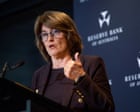
The Reserve Bank governor Michele Bullock has said that “some pain now will prevent even worse pain down the track”, after lifting official interest rates to an 18-year high of 4.85% in a bid to combat persistent inflation.
The RBA’s decision to hit mortgage holders for a fifth time in 2026 will intensify pressure on indebted households, but there were signs that the central bank will at least now wait through summer to gauge the impact of higher interest rates on the economy.
The decision split the monetary policy board, as six members voted for a hike, while three were in favour of a steady cash rate. Financial markets halved the probability of another rate rise before Christmas to 12%, but continued to price in a roughly 30% chance of a sixth hike by May.
Sign up for Guardian Australia’s Politics, really newsletter here
Speaking to journalists shortly after the rate decision, Bullock said: “I know this is not the news that many Australians want to hear, but it is what’s needed to get inflation down.”
“Inflation is too high, and our forecast suggests it will stay higher for longer. Some pain now will prevent even worse pain down the track,” she said.
The back-to-back hikes will heap more pain on over 3.3m households with home loans and turn the screws on a federal government under pressure for its economic management.
The latest rate rise will lift the monthly interest payment on a $700,000 home loan by $107, according to Canstar, bringing the total rise in repayments over this year’s five hikes to $532.
Jim Chalmers, the treasurer, said higher fuel prices due to the Middle East conflict were the “primary driver” for the recent inflationary surge.
“Our budgets are not what’s putting upward pressure on inflation. But we can play a helpful role and that’s what we intend to do,” Chalmers said.
With surveys showing Australians are increasingly inclined to blame the Albanese government for ongoing high cost of living, Angus Taylor, the opposition leader, said voters “deserved to hear the truth”.
“Labor’s spending spree is driving up inflation, it’s driving up interest rates, and Australians are paying the price,” Taylor said.
The RBA’s post-meeting statement removed an explicit reference to the need for further hikes – an omission that economists at UBS interpreted as “clearly dovish”.
And with the cash rate now at its highest level since 2008, Cherelle Murphy, the chief economist at EY, said the RBA “is likely to take a wait-and-see approach over summer”, even as she said higher interest rates could not be ruled out.
Household costs
The RBA’s latest set of forecasts in its Statement on Monetary Policy (SOMP) showed a difficult period ahead for the economy.
The forecasts suggested the country’s cost of living crisis would extend for another year, even as Australia struggles with below trend economic growth and climbing unemployment.
Inflation will push higher through the final months of 2026 to about 4.5% and only return below 3% – within the bank’s 2% to 3% target range – by the end of next year, or nine months later than hoped.
Global oil prices would ease over the coming 18 months, but still remain relatively elevated, according to the forecasts, suggesting limited relief from high fuel costs for motorists and ongoing high costs for businesses.
“We view the risks to the inflation outlook as still skewed to the upside,” the report said.
Alongside persistent cost of living pressures, the RBA also predicted weak economic growth through to the end of 2028.
The economy would grow by 1.6% this year and by 1.3% in 2027.
That would be well below an estimated potential growth rate of about 2%, but better than recent forecasts by bank analysts.
And despite the risks associated with a housing downturn that “is one of the steepest over the past 50 years”, the central banks’ economists saw no evidence that the country was headed towards recession over the coming two years.
Unemployment, now at 4.7%, would end next year at about 4.9%, before creeping over 5% in 2028.


