The bestselling author and reformed cartoonist on the ‘naughty frauds’ she admires, the challenges young people face, and why women read about having sex with fairies
Get our weekend culture and lifestyle email
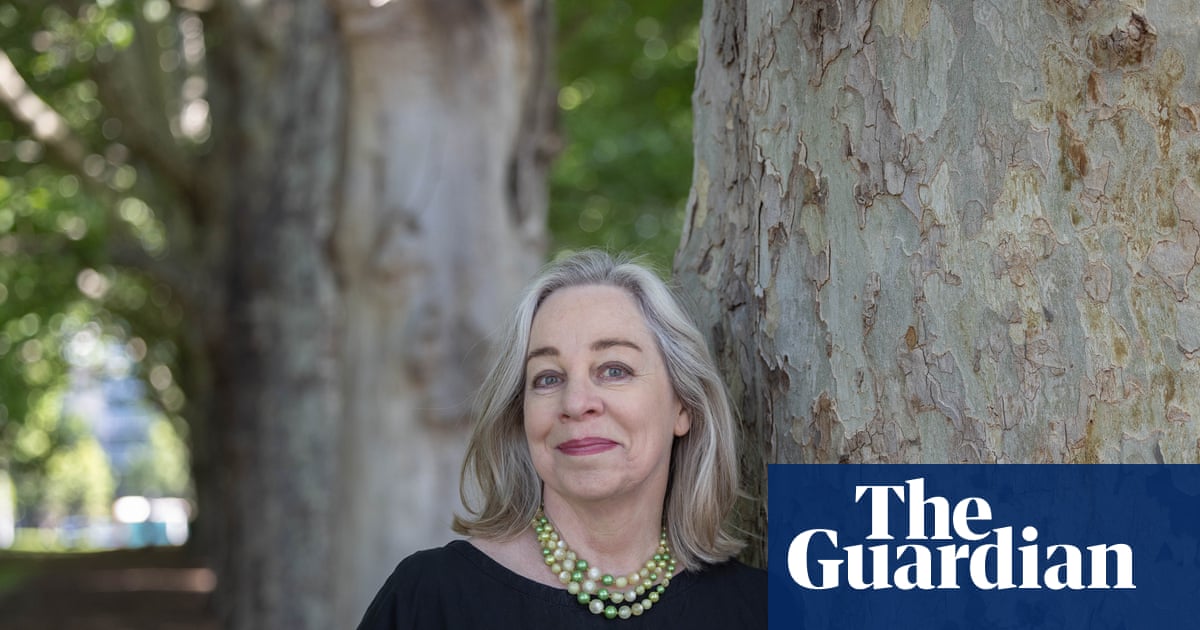
“I brought you a present,” author Kaz Cooke tells me, handing over a book titled Elvis Presley Speaks. A browning, dog-eared mass market copy, it’s the King’s account from beyond the grave, written by the parapsychologist Hans Holzer. It’s perfect – the sort of thoughtful, thematically relevant gift Cooke would have advised you to bring along in Keep Yourself Nice, the wacky advice column she once wrote for the Age. Or even an awkward moment for Hermione the Modern Girl, the original strip cartoon that launched her career as a cartoonist in the 80s. Her distinctive cartoon style decorates the cover of her 1999 pregnancy bible, Up the Duff, which adorns the bookshelves of many Australian women of a certain age. From there, Cooke’s output covered off on Babies and Toddlers, girlhood and puberty, and then It’s the Menopause (“What the hell is happening to your hair? Why do you want to bite everyone?”). We meet at the fountain of the Royal Exhibition Building on a stunning Melbourne spring day, Cooke in a flowing black dress and long pale hair. The weather has been grim and squally, and shall shortly be again, but the sun’s confidence and the slight breeze through the giant plane trees feel almost miraculous. Spooky, even.
Cooke is talking about her new book, Spooky Ladies, a historical account of women from the world of magic and the esoteric: mediums, clairvoyants, mind readers and magicians’ assistants. While she’s hardly the credulous type – “I don’t believe in mediums. I don’t believe in seances. All the evidence is in, sadly” – she became obsessed with the recondite women of history after a 2013 creative fellowship at the State Library Victoria that led eventually to her novel Ada, about a 19th-century showgirl.
She applied for the fellowship never having been to the State Library at all. “I thought it was a place of forbidding and forbidden things to the likes of me.” The fellowship opened her to the vast resources available to the public that these cultural institutions represent. “I’m obsessed with this idea that this information and these books belong to all of us.”
As a teenage cadet journalist straight out of high school in the 80s, Cooke had to dodge her share of bullying subeditors, male chauvinism and morning liquor, but she also found inspiration and excitement. “I was so gormless. A lot of the cadets were 10 years older, they were uni graduates. Some were very sophisticated but I wasn’t. I was always a bit outside and observing.”
Parlaying her journalism career into that of a cartoonist felt natural, even if it took some encouragement from industry figures like the late great Hilary McPhee, who published her first book. Not that she thinks of herself as a cartoonist these days, having ditched the daily practice required.
“Honestly, if it doesn’t have a pointy nose, I can’t draw it. And even that I stole from Ronald Searle.” She laughs, but then touches my arm. “It’s not false modesty. I think I’m good at some things. I’d like more credit for my caption writing. I’m not a brilliant cartoonist.”
We spot a distant bench empty up ahead, and make our way down the boulevard of trees towards it; the afternoon is so glorious, we’re happy to take our time in the sun and instinctually slow our step. We talk about the changes in publishing and journalism, the shrinking opportunities.
“It’s so much harder for young people. I really feel for them. There are not enough jobs. I got a job straight out of school; I got paid 17.5% leave loading. So I got a lot of chances.” While she may have entered a boys club, “it’s like they opened up a window and went, a few of you feminists come in”.
Sign up for the fun stuff with our rundown of must-reads, pop culture and tips for the weekend, every Sunday morning
But perhaps the biggest success of Cooke’s career, and in some ways most unlikely, is her series of instructional guides for women and girls, starting with Real Gorgeous in 1994 Cooke’s ability to share her vulnerability has resonated with women over decades as she’s candidly shared her own personal experience of formative life transitions alongside chatty, frank advice.
“It’s not a coincidence that I wrote books about how to do something because I did not know how to do anything,” she says. “I came from a suburban life where no one told me anything useful. I knew how to peg a shirt on to a line along its seams. As preparation for life, it wasn’t great.”
We’re almost at the bench when a couple sneak right up and take it. We sigh. There’s another bench further along and we head for that one. “I hate that idea of being a guru, as a parent or anything else,” she says forcefully as we chat about how the guidebooks made her something of an expert in the public eye. “I hate it. I think it’s such bullshit to say you are an expert on something.”
Yet another bench is taken from us as we approach – it’s beginning to feel either like a flashmob or a spy film, and we can’t tell which is worse – so we try one last one, crossing the grass and heading to the edge of the Carlton Gardens. Given Cooke updates her guides annually, I wonder what she feels about the manosphere and the rise of misogyny. Is she pessimistic about the future of gender relations?
“I’m optimistic,” Cooke says cautiously. “Young women are fantastic. They don’t have to solve it, they’ve done their bit.
“A lot of young boys are ill served by their parents and their schools, and if they change, things will be fantastic. But if they don’t, there’s just going to be a further and further schism between [men and] women, who’ll just go read about having sex with a fairy.”
This image of proto-feminist women swanning off to have adventures on their own terms – men either a mark, a prop or an inconvenience – is a persistent theme in Cooke’s conversation about her spooky ladies. She speaks with affection for the female subjects of her book: “I did feel at the end that we would have been friends. I admired them so much, even the ones who were terribly naughty frauds.”
One of them, the impossibly glamorous magicians’s assistant from Geelong named Moi-Yo Miller, was my great-aunt, who was billed as “Australia’s most beautiful woman” and estimated that she had been sawn in half about 11,800 times.
What emerges from the pages of Cooke’s book is the sheer chutzpah of these women, whether they were sophisticated entertainers or dodgy charlatans. My great-aunt was a family marvel, trailing a sense of faded Hollywood glamour with her until her death at 104, but she is awarded a more thorough place in history here as an artist and entertainer.
“I love that quote about Moi-Yo, that she folded up like a piece of silk,” says Cooke. “But she was doing incredible things. She was the art director, she chose the music, she went shopping for the costumes, she did the staging. She was, I think, the first woman to be credited as an art director of a major stage show in New York.”
“All of them are emblematic in some way of their time,” she adds. “They were denied education, they were denied training, they were denied jobs, denied contraception. So many of them were just making their own way in the world with what they could.”
They fit into a continuum of ignored and marginalised women going back to the days of witchcraft. “Witches were literally tortured and murdered for having herbal knowledge.” And when spooky women did gain attention in the world of Spiritualism, it was usually as a vessel or conduit. “A tube, even!” Cooke laughs.
We walk a little distance together back towards the city before parting ways. When I get home, I have another look at the book Cooke gifted me. It turns out Hans Holzer is just the transcriber. The medium who actually communes with Elvis is a woman, “a timid, soft spoken housewife named Dorothy Sherry”. She doesn’t appear anywhere on the cover.
Spooky Ladies by Kaz Cooke is out now through Simon & Schuster