Exclusive: Public institutions get first chance to bid for rare ‘wonderbook’ of apocalyptic visions and extreme weather
In one illustration, five suns blaze down on Leipzig in 1551. In another, blood rain falls on Rome in 1456. In a third scene, dated 1552, monstrous hailstones batter the Dutch city of Dordrecht during a storm so fierce people feared Judgment Day had come.
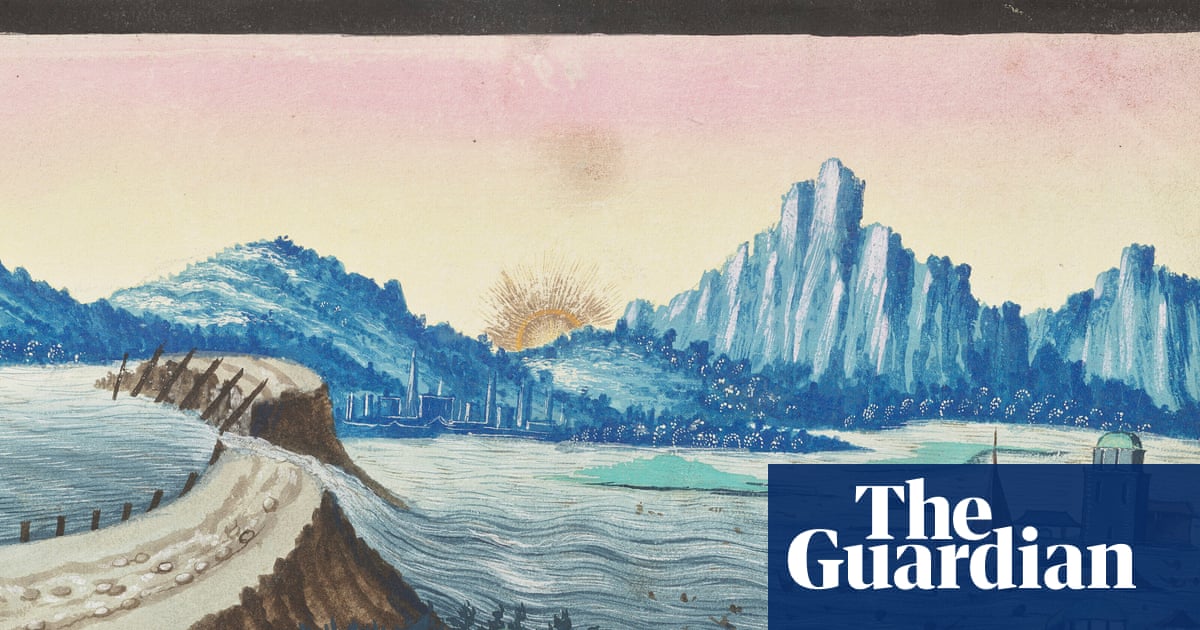
Created during the mid-16th century, when earthquakes, storms, floods and other extreme weather events were often interpreted as ominous warnings from God, the Book of Miracles contains 167 paintings of apocalyptic visions, celestial wonders and meteorological phenomena.
It is the only known copy. To this day, no one is sure why it was created.
Now, public institutions will have their first chance to bid for the Book of Miracles since scholars learned it existed. It is expected to fetch between £700,000 and £1m when it is auctioned in London on 10 December, as the star lot of the Christie’s valuable books and manuscripts sale.
Members of the public will also have a rare opportunity to see it in person for six days before it goes under the hammer.
For nearly half a millennium, scholars were unaware of its existence. Found in the library of a small baroque castle in southern Germany nearly 20 years ago, the manuscript, which from 1550s Augsburg, was put up for auction alongside the castle’s furniture, carpets and tankards in 2008 and sold for just over £100,000.
Shortly after the sale, the manuscript entered the private collection of Mickey Cartin, one of Connecticut’s biggest contemporary art collectors.
Eugenio Donadoni, Christie’s international specialist in medieval and Renaissance manuscripts, said the book was an “exceptionally rare” German wonderbook.
“German wonderbooks functioned as the sensationalist mass media of their day,” he said. “They were used by Lutheran theologians such as Martin Luther and Philip Melanchthon to further their Protestant eschatology, but crucially – with all the depictions of comets, cosmological events, natural disasters, all verified by witnesses, with exact dates and geographic coordinates – they laid early foundations for empirical observation and reporting. They mark a shift from medieval to Enlightenment.”
He expects the sale will attract collectors of both historic and modern art because some of the scenes, which are painted in watercolour and gouache, are “super surrealist … almost Dalí-esque”.
“If it weren’t for the little captions, which are obviously 16th-century German, some of them look so vividly modern … it’s really jaw-dropping,” Donadoni said.
The scenes depicted include a plague of locusts arriving in Poland on a “terrible wind” in 1527 and the North Sea flooding the coast of Frisia – in what is now the Netherlands and Germany – in 1230.
Other pictures are of fiery comets and eclipses, while scholars think an illustration of “wondrous dragons” flying across the sky over Bavaria in 1533 depicts the northern lights.
Underneath each scene, a German picture caption describes what is happening and where and when the event took place.
“All of these events are portentous,” said Donadoni. “The artists of the Book of Miracles, relying on contemporary broadsheets, chronicles and histories, have condensed into pictorial form the concerns of an age that was gripped by an anxiety – and learned curiosity – about the future.”
The book records how uneasy people felt about climatic anomalies at a time of doctrinal disunity, when there was growing interest in documenting and cataloguing visible, tangible scientific phenomena, he said.
“It’s really fascinating … it is a window into how Europeans were dealing with the impending end of the world, political uncertainty and extreme – and strange – weather events.”
The five suns over Leipzig, for example, is thought to depict the optical illusion of a parhelion, more commonly known as a sun dog. “You see in the sky various different rings of light and it looks like suns,” Donadoni said.
“Blood rain” occurs when high concentrations of red-coloured dust particles, usually from the Sahara, mix with water droplets in rain clouds. “Many of these things have actual rational scientific explanations to them,” Donadoni said.
He said he imagined that leafing through the pages of the book in the 1550s was similar to bingeing on bad news on social media today: “I think it could be a little like the 16th-century version of doomscrolling.”
In this way, the book straddles a momentous turning point in history. “We’re right at that period where the superstition of the middle ages turns into the age of scientific discovery,” Donadoni said.
Till-Holger Borchert, the director of the Suermondt Ludwig Museum in Aachen, has studied the manuscript and said the first time he saw it, his reaction was: “Wow”. “It’s one of a kind,” he said. “It grabs you by your heart or your soul or your belly.”
He said he thought £1m was a “very conservative estimate” of its value. “It [the final price] could possibly be much more,” he said.
A facsimile of the manuscript was published in 2013 that got people “really excited” about it, Borchert added, and since then the Book of Miracles has become “a kind of icon for people who are interested in apocalyptic things”. It would be wrong to value it merely as an historical document: “It’s more than that. It speaks to us, to our generation.”