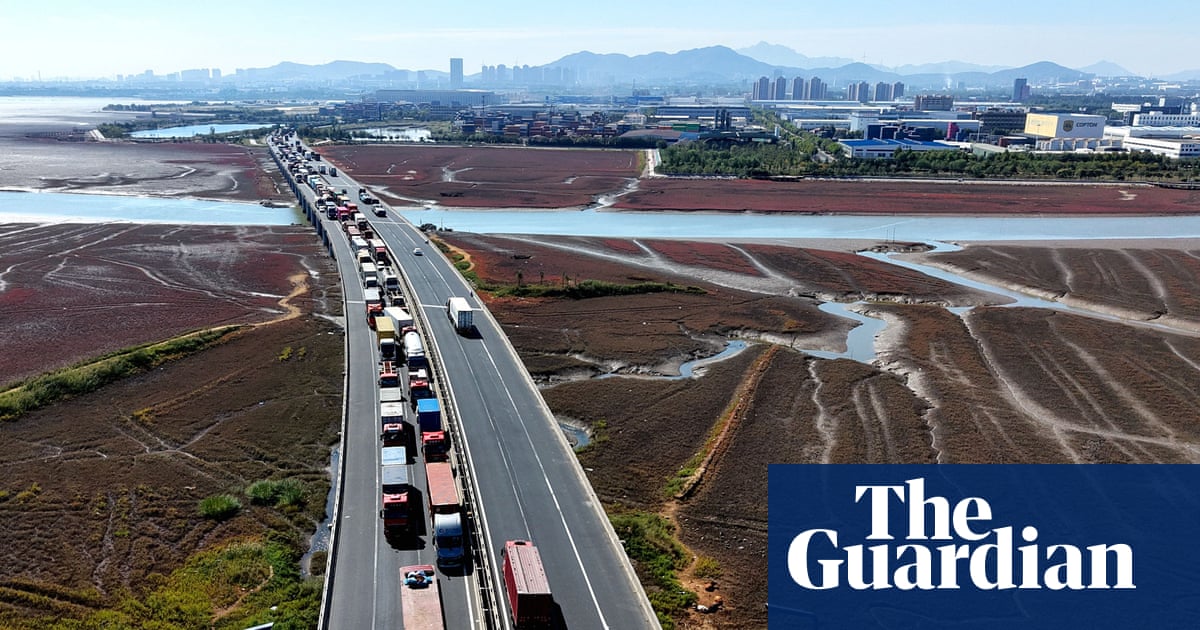
Battery maker CATL aims to have 2,000 swapping stations in China by the end of 2027 and to bring the tech to Europe
Every day, Wang Bing drives his big electric lorry to send around five tonnes of goods between the cities of Haikou and Dongfang on Hainan, a tropical island in southern China. A round trip covers about 500 kilometres (310 miles). But refuelling is not something Wang worries about.
“When my battery runs low, I just drive my truck into a battery-swapping station to get a fully charged one,” says the 53-year-old, who shares the journey with a colleague in eight-hour shifts.
Wang has been a lorry driver for nearly three decades. In the first two of those, he drove conventional lorries fuelled by diesel. About five years ago, he began driving an electric model after the logistics company he worked for upgraded its fleet. In July this year, his old e-truck, which used conventional plug-in charging, was replaced by one with a swappable battery.
In the past, Wang had to spend an hour and half charging his battery each time, but with his new truck, it takes just five minutes or so to have a drained battery removed and a fresh one replaced. “I am very happy,” he says.
Battery swapping is not new in China, where more than 400,000 e-trucks (or over 90% of the global total) were sold last year. The Chinese carmaker Nio commercialised the technology nearly a decade ago for smaller electric vehicles (EVs). But in 2023, the Chinese battery behemoth CATL launched a battery-swapping system for electric lorries through a subsidiary brand called Qiji Energy.
To Wang, the biggest advantage of the technology is the time it saves. “It is much, much faster,” he says. “I don’t even need to leave my truck when the battery is being swapped.”
This swiftness builds on the cost advantage e-trucks already have over their fossil-fuelled peers when it comes to refuelling.
“Electricity is cheaper than oil,” Wang says. The per-kilometre fuelling cost for an e-truck works out about 1.1 yuan (12p) in Hainan, he says, significantly lower than that for a diesel truck, which exceeds 2 yuan (22p) a kilometre. “That means my e-truck can save more than 20,000 yuan (£2,200) per month,” Wang says.
When a truck approaches a battery-swapping station, the station’s cameras automatically identify the type of battery it uses by checking its number plate. “All the driver needs to do is to drive the truck into a designated area, and the battery will be swapped completely automatically,” says Wei Jiuchun, 46, a test driver at a Qiji Energy battery-swapping station in Suzhou, east China. Wei’s job is to help the station test its system for different models of heavy trucks and under different weather conditions.
It is not just time and fuel costs the technology saves but, in China, the initial lump sum a buyer has to put down to get an e-truck, says Mao Shiyue, a Beijing-based researcher at the International Council on Clean Transportation (ICCT).
The upfront purchase price for an e-truck is significantly higher than for a comparable diesel model, a major obstacle for those vehicles’ wider adoption in many parts of the world. In China, a customer opting for battery swapping typically buys an e-truck without a battery, and then rents the battery from a service provider. As the cost of a battery is about 40% of an e-truck’s price, the business model can make e-trucks a lot more affordable, Mao says.
The technology can also help minimise the pressure EV charging brings to the power grid, according to Mao, because swapping stations have more flexibility to spread out the charging time for the depleted batteries.
“If the grid sees a spike in electricity demand during peak hours, those stations can even act as an energy-storage station by returning the electricity stored in their batteries back to the grid to ease the strain,” he says.
CATL, the world’s biggest battery manufacturer, is a key player in promoting battery swapping for heavy trucks in China. The company’s support for the technology is critical for its large-scale rollout, says Phate Zhang, the founder of CnEVPost, a Shanghai-based outlet focusing on EVs.
CATL plans to put 900 battery-swapping stations into operation across China by the end of this year, expanding its current network twice more. By the end of 2027, it wants the number to reach 2,000.
The company has also teamed up with the London-based renewable energy supplier Octopus to bring the technology to Europe. It intends to open its first group of battery-swapping “mega hubs” in the UK next year, and a network of more than 30 hubs in Europe by 2035.
In China, battery-swapping is still a minority charging method for its rapidly growing e-truck fleet. In 2024, about one-third of the zero-emission trucks in the country featured this technology, while the rest largely had conventional plug-in charging, according to the latest available figures.
One downside is that drivers often need to stick to a particular service provider that caters to the specific type of swappable batteries their e-trucks use.
“For example, some batteries are swapped from the chassis, while others are swapped from the top of the truck,” says Xue Lulu, a senior associate at World Resources Institute China. “Even under the same technological route, batteries made by different companies often have different specifications.” This means drivers cannot drop into any random swapping station to get their trucks replenished, which could restrict the journeys they can make, she says.
Plus, battery swapping doesn’t necessarily mean drivers will save time, Xue says. During her field research in China, she found some lorry drivers would wait outside battery-swapping stations for one to two hours before going in because they wanted to avoid using the service during peak hours, to save money. “Logistics firms are extremely sensitive to costs,” she says.
The most suitable users are probably drivers who, like Wang, work on fixed routes served by battery-swapping stations. Mao says the charging method has been rolled out most successfully among companies that use heavy trucks in specific settings, such as those carrying goods in ports and factories, as well as within a city or between two nearby cities. “For unpredicted and long-haul routes, there are still challenges for rolling it out on a large scale,” he says.