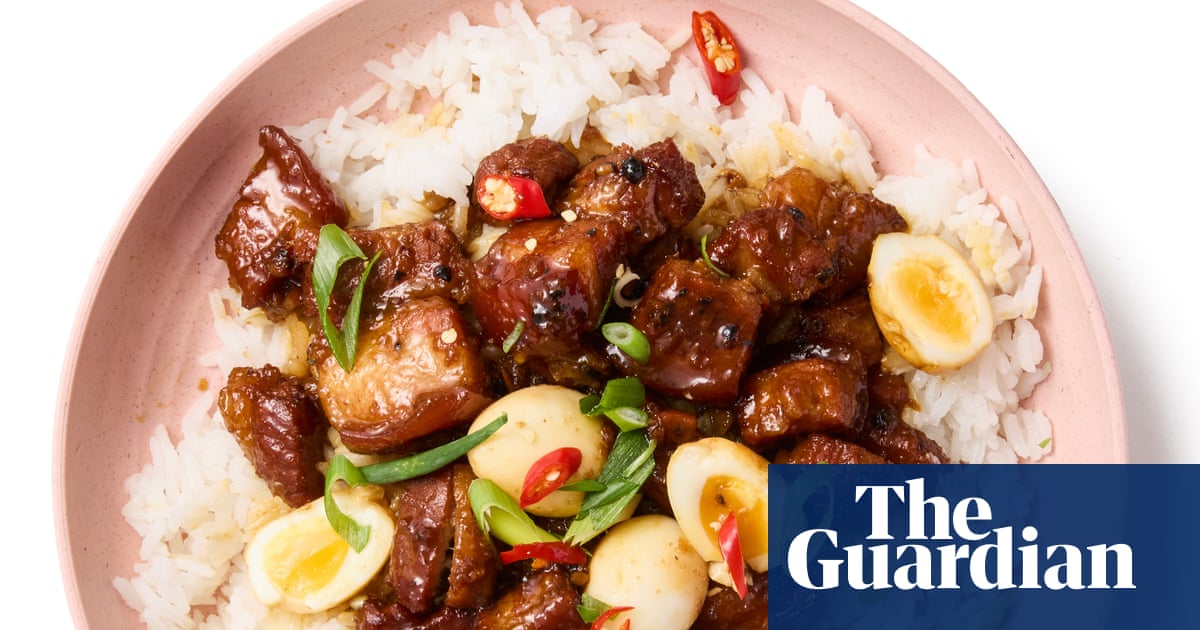
Slow-cooked pork in a deliciously sweet-salty glaze is Vietnamese comfort food at its best
Many moons ago, I attended a cookery class in Hanoi that revealed to me the glories of thịt kho tàu, a simple but unbelievably delicious dish of caramelised pork braised in sweet coconut water and savoury fish sauce, enlivened by plenty of black pepper. In fact, loved it so much that I put their version in my cookbook, The A to Z of Eating, and then somehow forgot all about it for a decade. It’s easy to do that when you’re always working on the next recipe, but this week has been a very welcome rediscovery, not least because I’ve learned a lot more about what chef Thuy Diem Pham describes in her book The Little Viet Kitchen as “the ultimate home comfort food”.
A family favourite, it’s also traditionally served as part of the lunar new year celebrations, because, in the words of Andrea Nguyen, “Tet is for savouring abundance, which explains why this rich, savoury braise of pork and eggs in bittersweet caramel sauce is a must-have”; and also, according to blogger Hungry Huy, “because of how well it keeps after cooking”. It’s so rich and full-flavoured that all you need to go with it is rice to soak up the sauce and perhaps a dish of pickled greens as a nod to health.
The meat
If you don’t eat pork, then you could substitute skin-on, bone-in chicken thighs, a well-marbled cut of beef or even breast of lamb. If you don’t eat meat, there’s a good-looking tofu and mushroom version here; vegetarians could augment this with boiled eggs. Pork is, however, the most popular traditional choice.
All the recipes I try call for belly, but some mention that you could substitute leg or shoulder, or use a combination of lean and fatty cuts. I think leg is wasted here; slow cooking leaves it soft but dry. Shoulder works better, but, in the words of Nguyen in the New York Times, “if using pork shoulder, choose a fatty portion … if choosing pork leg, select the meatier upper butt portion rather than the lower shank portion”. My preference is for belly, because the fat is more evenly distributed, which means there are no lean and fewer purely fatty pieces. That said, all pigs are not created equal, and the free-range pork in my nearest supermarket is noticeably leaner than the stuff from my favourite butcher, so you’ll need to base your decision based on what’s available to you: Huy notes that his “ideal ratio of pork for this dish is actually three-quarters pork belly and one quarter a leaner cut such as shoulder. Pork belly and fat is tasty, but sometimes, when the fat-to-meat ratio isn’t right in it, I’m left with just hunks of fat and nothing to balance it out with.”
Whatever you go for, leave the skin on, if possible: “Some may find cooking with the fat and rind of the pork unappealing,” Ann Le accepts in her Little Saigon Cookbook, “but braising with the fat makes for a more flavourful dish.” If you’re lucky enough to be dealing with a real butcher, and they ask if you’d like the bones left in, bite their hands off – bones always equal flavour, and the meat will just fall off them after such slow cooking, though you’ll need to adjust for their weight.
Chef Tu David Phu “blanches” the meat for 10 minutes in simmering salted water first – in other recipes, he describes this as “cleaning it”, apparently common practice to rid the meat of any gamey flavour and clarify the sauce. No one else bothers, though, and I rather like the flavour of pork, so I’ve skipped this step in favour of skimming the pot instead. It’s easily added back in, if you’d prefer.
The aromatics
Pham is the only one to marinate the meat, overnight in a mixture of bird’s eye chilli, Asian shallots (the very small round ones), garlic, sugar, salt and lime juice. Uyen Luu’s book Vietnamese suggests mixing the meat with the chopped shallot and garlic before cooking, while Nguyen adds onion, Phu adds ginger and chilli , and both add garlic to the pan separately. Le, meanwhile, eschews aromatics altogether, save for a generous dose of coarsely ground black pepper.
I haven’t marinated the meat; pork belly is full of flavour anyway, and I’d like to taste it as well as the sauce. In fact, I’m going to keep things as simple as we did all those years ago back in Hanoi, with just ginger – I like its sweet spice with the caramel, but you might substitute the fierier Asian red shallot instead. I’ll also add garlic, plus plenty of black pepper, whose earthier heat I prefer to the fresh bite of chillies in this instance – though it wouldn’t hurt to add some thinly sliced red bird’s eyes at the end for a pop of colour, or indeed Le and Tu’s spring onions.
Sweet and salty
For something so simple – browned sugar – there’s a surprising diversity of caramel-making methods among this modest selection of recipes. Luu fries the sugar in oil until caramelised, then adds the pork, and Le informs her readers that, while “some cooks like to create a caramel sauce to pour over the food ... I prefer to cover the meat with a generous amount of sugar and brown it, which produces a nice caramel coating, as well as permeating the food with a light taste of sugar”. Some cooks, including Huy, Pham and Nguyen, make a caramel in a separate pan, and add it to proceedings later in the cooking process.
Though the idea of literally caramelising the meat in hot sugar is an attractive one, in practice I find it hard not to burn something, usually either the sugar or the garlic. As well as being inept, however, I also dislike unnecessary washing-up, so, as in the recipe from Hanoi, I’m going to caramelise the sugar, dilute it so it’s less likely to catch, then toss the pork and aromatics in it to coat before pouring in any more liquid. Not least because the lengthy braise that follows will give the meat plenty of time to absorb other flavours, anyway. Luu finishes the dish with coconut syrup or sugar, which is a nice touch if you happen to have either knocking about, but they’re probably not worth sourcing especially.
Le uses the most fish sauce (more than five tablespoons for a mere 225g meat), while Pham and Huy allow a mere three tablespoons’ worth for four times as much. Add it to taste, but I prefer to err on the generous side to balance the sugar, as well as to pick up the savoury notes in the pork.
The liquid
We used fresh green coconut juice in Hanoi, but most recipes, clearly aimed at markets less blessed with tropical produce, call for coconut water. The only exception is Huy, who prefers Rico Puerto Rican coconut soda, which is even harder to source in London than fresh coconuts. Happily, he allows the substitution of “Coke or 7-Up ... at a pinch”, and Coke, which feels as if it makes more sense than lemonade, is very easily obtained from the garage across the road. Unfortunately, it doesn’t taste as nice as coconut water, which is now quite easy to come by, so I wouldn’t recommend it.
Nguyen reduces the sauce once the pork is cooked, but, good as her recipe is, I find you can avoid this by using a little less liquid in the first place.
The eggs
One of the things that makes this a relatively economical meat dish is the addition of hard-boiled eggs, which supply extra lean protein (and, depending on which cut you go for, possibly quite welcomingly so). I like to add them towards the end – they’re already hard-boiled, so there seems little value in cooking them to death – and though I fail to source any in time to try, I love Luu’s suggestion of substituting dainty quail’s eggs if you’re serving this to guests.
The cooking time
Phu leaves the meat to simmer away for half an hour after its initial 10-minute blanch, but most recipes recommend a little, or indeed a lot longer: three whole hours in Pham’s case. I find the sweet spot is just under two hours, but the precise timings will, of course, depend on the meat you use, the hob itself and the pot that goes on it.
Serving
Luu observes that “this dish is usually cooked with having leftovers in mind, especially as the flavour improves after a few days, so it’s ideal to keep in the fridge and enjoy later”. Serve with steamed jasmine rice and pickled mustard greens.
Perfect Vietnamese caramel pork
Prep 20 min Cook 2 hr Serves 4
1 tsp black peppercorns 750g pork belly, or well-marbled shoulder, skin on if possible 3 tbsp sugar , preferably white 1 tbsp finely grated ginger 4 garlic cloves, peeled and crushed 330ml coconut water 3 tbsp fish sauce, or to taste 2-4 eggs, or 4-8 quail eggs, depending on hunger Red chilli and/or spring onion, to serve (optional) Rice and pickled greens, to serve
Boil the kettle. Lightly bruise the peppercorns in a mortar or under the flat side of a heavy knife. Cut the pork into large, bite-sized pieces, where possible trying to ensure each has a good ratio of fat and lean.
Put the sugar in a large saucepan (preferably not one with dark or black insides, because this makes it harder to judge the colour of the caramel later) and turn on the heat to medium. Keep an eye on it as it melts and begins to colour.
Once the sugar is melted and a deep golden brown, stir in 100ml hot water, followed by the peppercorns, ginger, garlic and pork, and toss to coat in the caramel.
Pour in the coconut water and fish sauce, bring to a simmer, then skim off any cloudy scum from the top, if need be. Turn down the heat, cover and leave to cook gently for an hour and three-quarters.
Meanwhile, hard-boil the eggs by cooking them in boiling water for 10 minutes (or, if using quail eggs, a minute and 45 seconds), then dunk them in cold water to stop them cooking further. Once cool, tap the blunt end of each egg against a counter to crack it, then put them back under cold water and peel.
Add the eggs to the pork pan for the final five minutes of cooking, just to warm through. Taste the sauce and add more fish sauce, if necessary. If it’s too oily for your liking, pour the liquid into a glass jug or gravy separator and, once the fat has settled, spoon or pour it off the top and return the sauce to the pan. Top with finely sliced red chilli and/or spring onions, and serve with rice and pickled greens.
If you were fortunate enough to grow up with this delicious dish, please share your memories and recipe ideas – and, if not, which other Vietnamese dishes would you like to see this column cover?