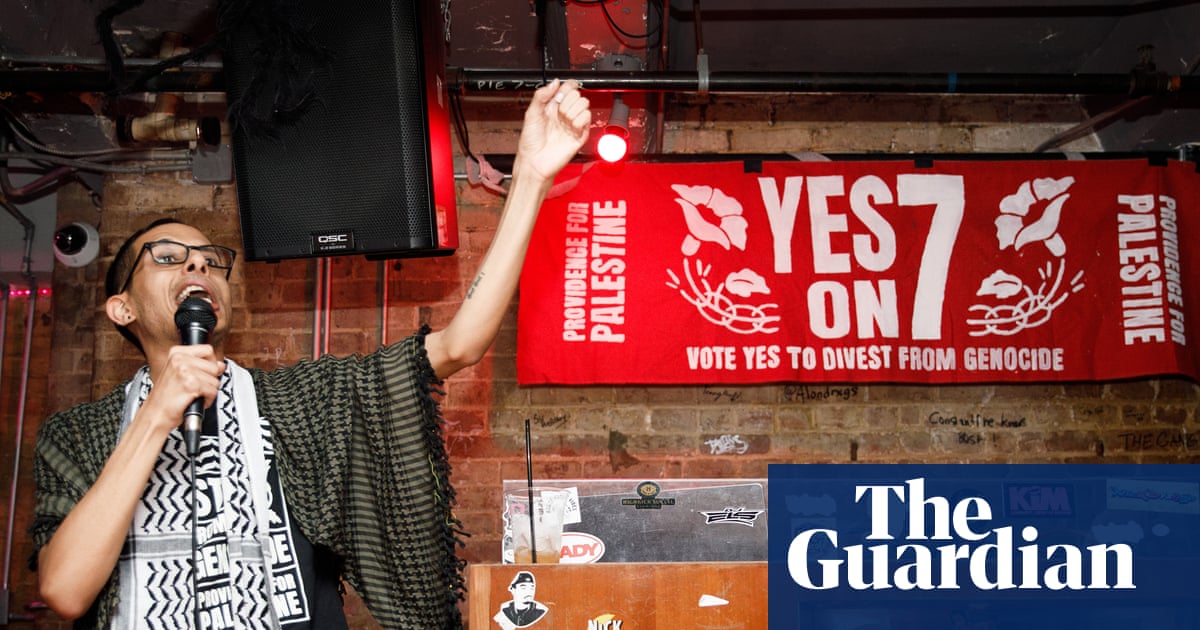
Voters in Providence, Rhode Island, chose to pull foreign investments from countries that profit from genocide
The tectonic blue wave that washed over the country in last week’s midterms also brought about a historic night for the pro-Palestine movement.
Up and down the ballot, candidates who demanded an end to Israel’s war in Gaza resoundingly defeated opponents funded by the pro-Israel lobbying group American Israel Public Affairs Committee (Aipac).
Providence, meanwhile, became the second US city to vote to divest from Israel. Voters in the Rhode Island capital approved a ballot measure last Tuesday requiring the city to refrain from investing in foreign countries that profit from “genocide, apartheid, ethnic cleansing and prolonged military occupation”.
Passing with 75% of the vote, the victory aligns with public opinion’s souring on the Israeli government. One-third of Americans – including a similar share of Jews – say Israel has committed genocide against Palestinians, and more than half say they want the government to stop sending weapons to Israel, according to recent polls. Organizers say the success of Providence’s ballot strategy is built on both the broad public support for divestment and a canvassing operation that can be replicated by pro-Palestinian groups in other cities.
“When we were out on the streets, we were overwhelmed by the positive results, by people who were so thankful to have a meaningful opportunity to do something about Palestine,” said Adit Sabnis, a graduate student at Brown University and local union organizer with the American Federation of Teachers (AFT) Local 6516, one of the groups that led the Providence ballot push. “This is an overwhelmingly pro-Palestine and anti-genocide city.”
How Providence divested from Israel
The Providence for Palestine campaign launched a little less than a year ago with just 40 volunteers, said Zack Kligler, an organizer with Jewish Voice for Peace – Rhode Island. Led by the local chapters of Jewish Voice for Peace, the Democratic Socialists of America (DSA), AFT and American Muslims for Palestine, as well as the local housing justice organization Reclaim RI, the group decided to pursue a ballot strategy after traditional legislative efforts failed.
In 2024, then-mayor Brett Smiley and other city councilors blocked an ordinance to divest from Israel, and officials at Brown University, an Ivy League school in the city, rejected a similar student-led proposal. At least $2.5m in city funds were invested in companies directly profiting from what organizers call a genocide in Gaza and Israeli apartheid. The city also held more than $2m in Israeli bonds as recently as 2022.
Over the spring and summer, the coalition collected more than 10,000 signatures – twice the required threshold to qualify the measure. Organizers then built out an enormous canvassing operation, with nearly 300 volunteers stationed at street corners, businesses and community events across the city. Leading up to the midterms, they knocked on 17,000 doors, made 18,000 phone calls and talked to 30,000 neighbors about what’s happening in Gaza and what divestment entails.
Jackie Goldman, an incoming Providence city councilor and key organizer for the divestment measure, said few voters at the start of the campaign season knew of the city’s investments in companies with Israeli ties. But upon learning about the ballot initiative, Goldman said, most people were eager to support and saw divestment as “an empowering action”.
Though a broad coalition of Providence residents came together in support of divestment, the campaign was powered by many Jewish organizers and voters.
“It’s a demonstration that the idea that US Jews are in line behind Israel is just absolutely false,” said Kligler. “We ended up mobilizing Jews across the city, and we won every ward, including the most heavily Jewish ones.”
Organizers say the overwhelming success of the measure was bolstered by the electoral victories of a slate of progressive, pro-Palestinian candidates in the city’s September primary, including Goldman and mayor-elect David Morales, a DSA member who defeated Smiley. Both candidates gathered signatures for the measure while canvassing for their own campaigns.
But rather than pro-Palestinian groups endorsing specific candidates, Kligler said, Providence has shown that advocates themselves can take a more proactive role in shaping legislation: “This is a case of not just the movement getting behind candidates – it’s the movement forwarding its own policy priorities and pulling candidates behind it.”
How other cities are looking to divest
Kligler said one of the top priorities for Providence organizers was creating a replicable blueprint for other cities. The Providence for Palestine coalition posted a call on Instagram encouraging organizers across the country to reach out and discuss the lessons and tactics from the city’s win. Kligler said the coalition was not actively working on another ballot effort yet, but organizers in different cities had reached out.
Providence organizers themselves studied ballot efforts in Somerville, Massachusetts – the first US city last year to vote to divest from Israel – and Pittsburgh, Pennsylvania, where a divestment referendum was blocked by a legal challenge. Kligler said Pittsburgh organizers were especially helpful in providing guidance on how to check that addresses were correctly written and petitions were signed in acceptable colors so that they couldn’t be disqualified based on a technicality.
A handful of other cities, most recently Cambridge, Massachusetts, have also divested from companies with Israeli ties through city council resolutions, not by popular vote.
On election night, officials in Palm Beach county, Florida – the world’s largest local government investor in Israeli bonds – also voted not to reinvest $67.5m in bonds that had matured on 1 November. The decision followed months of sustained organizing from local activists with the “Our Taxes, Our Needs” campaign, who sued the county and showed up in droves to board meetings, putting pressure on officials.
Advocates are looking to block three more investments in Palm Beach that are set to expire over the next couple of years, said Lydia Ghuman, executive director of the Internationalist Law Center, which has been leading the county’s effort to divest from Israel. The next step is to pass policies redirecting these bond investments into housing, education, healthcare and other local needs – a more appropriate use of taxpayer funds than enabling violence, Ghuman said.
“The compass that fuels us is injustice,” she said, “but these are also just poor investments, especially in Florida, where many people work three jobs.”