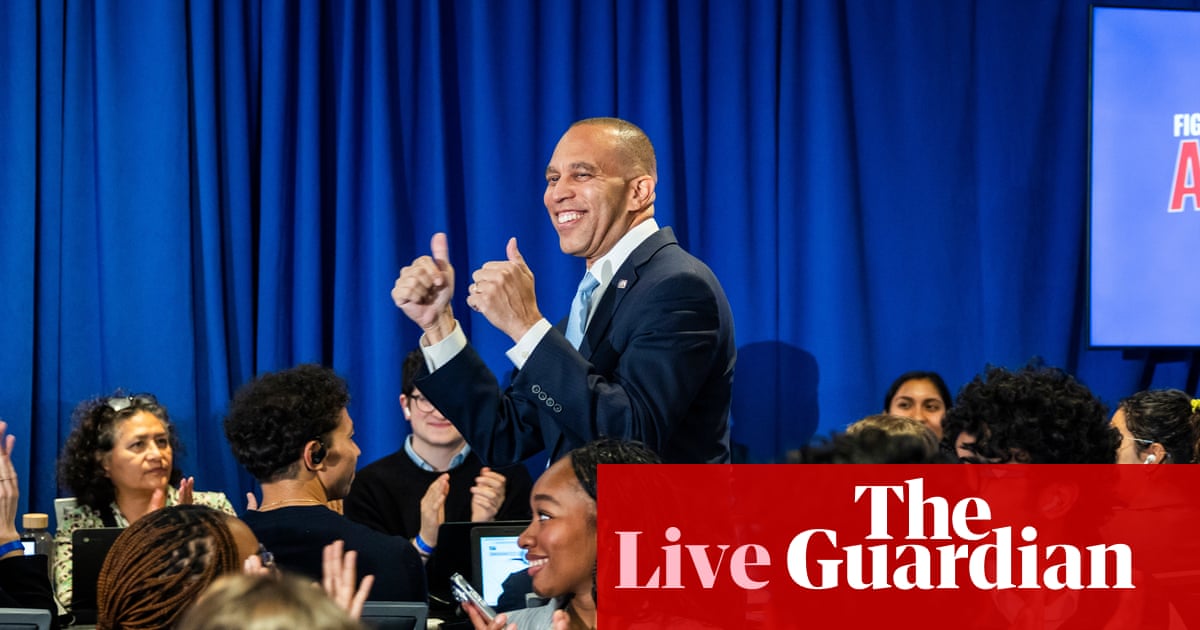

Fred Wellman, host of the progressive podcast On Democracy, defeated longtime incumbent Republican Ann Wagner
Fred Wellman’s victory in Missouri’s second congressional district on Tuesday was such a surprise that NBC News’s star data analyst Steve Kornacki didn’t even have a graphic prepared, he told supporters on election night.
Longtime Republican incumbent Ann Wagner, who had been widely expected to hold her seat, was swept aside as part of a broader wave of Democratic victories across the country.
Wellman, 61, had a lengthy career as an officer in the US army and later as a veterans advocate, but he is better known as an anti-Donald Trump, pro-democracy online media personality with more than 358,000 followers on X. (He met his fiancee on the social media platform, he said.)
He hosts a podcast called On Democracy for the progressive, anti-Trump MeidasTouch network, making him a non-traditional choice in a predominantly conservative state like Missouri. “Fred has always been a fighter and a powerful voice for the people when it matters most,” said MeidasTouch co-founder Ben Meiselas. “We’re incredibly proud of his success and thrilled to see him win.”
Wagner attempted to use Wellman’s media career against him, playing up his self-description as a “flaming liberal” several years ago on a podcast in a campaign advertisement.
While Wellman’s podcast, which he began four years ago, certainly raised his national media profile, he said he intentionally emphasized his local roots growing up in Kirkwood, Missouri.
“I didn’t want to be a national figure or national anti-Trump guy,” he said. “I wanted to be Fred from Kirkwood. And I think one of the reasons we won this race is because instead of trying to be this ‘famous person’ who’s running for his local office, I always said my job is to represent the people of Missouri. And I think that was a key strategy decision that I think paid off for us.”
This interview has been condensed and edited for clarity.
Were you surprised to win?
No, I thought we would win. I was nervous, obviously. I thought it was 50/50. I believe a lot of folks were saying it was a toss-up. I was always worried about the amount of ads [Wagner] was able to run … But I knew from being present in the district and talking to people that we could do it, that we’ve created a bipartisan, a nonpartisan movement, that I had captured the coalition I needed to capture, which was all of labor came in with us, short of police and fire. And even the rank-and-file of the police and fire were backing me.
Why did you try to de-emphasize your national media and social media career when running for office?
I think it’s off-putting to people who are local. I think a lot of times it feels like they’re being used for your national ambitions, or that you want to be famous. I think especially for me, as being a social media person that was well known – somewhat, if you will – online, that people dismissed me as just looking for more clout. And I wanted to make it very clear: no, I was running to be a congressman representing 759,000 people of eastern Missouri. We were very focused on that. And then we showed it personally by being everywhere in the district and meeting people where they are, not relying solely on being internet famous. And I think that’s one of the reasons we did so well.
What did your family originally think of your decision to get into podcasting?
It’s a running joke that when I told my fiancee I wanted to start a podcast, she thought that was a terrible idea because it’s a little cliche being a middle-aged white guy with a podcast. But it was a great platform for me to tell my story – not my story, that’s the wrong way to put it – but to talk about democracy, talk about the threats to democracy, highlight some of the incredible voices: journalists, authors, politicians, thinkers. I’ve really enjoyed doing it. It’s been a great place. I’ve learned a lot. And the nice thing about doing it for so long – four years of doing a podcast – there are very few issues I hadn’t seen. So when it came time to be a congressman or a candidate, there’s very few things that hadn’t come across my radar at some point.
Did you think your candidacy caught Wagner off-guard?
Yes, absolutely. Well, we were considered safe even within the national movement. The Cook Political Report never moved us off as “safe Republican”. Never. I think the prognosticators felt that as a 34-year Republican seat, a 14-year incumbent who started out with $4.5m to my zero, and me not having that kind of wherewithal, they took the fact that the [Democratic Congressional Campaign Committee] and the other big national groups never came in, as a sign of weakness within my campaign … As we looked at the numbers and we looked at what was possible, I saw a real opportunity. I believed that Representative Wagner was much, much weaker than people realized. And I believed there was a chance, and I think my instincts proved out.
So, you’re heading to Washington DC on Sunday?
Orientation starts this Sunday. Got to figure out how to be a congressman. Congressman 101 … I’ve done public service. Same oath I swore as a 17-year-old, but obviously it’s a very different kind of service. Like I said, I’ve got 759,000 bosses now. I’ve got to answer to people who may not agree with me, who didn’t vote for me. And I owe them as good as I can do, and I owe them to be transparent as much as I can be and I owe them to be honorable.