
Former military chief says prime minister brought Israel to historic crisis and it is approaching ‘point of no return’
Israel’s former military chief Gadi Eisenkot started the tough task of forming a government on Sunday, reaching out to Benjamin Netanyahu’s allies as he said the veteran prime minister had brought the country to a historic crisis.
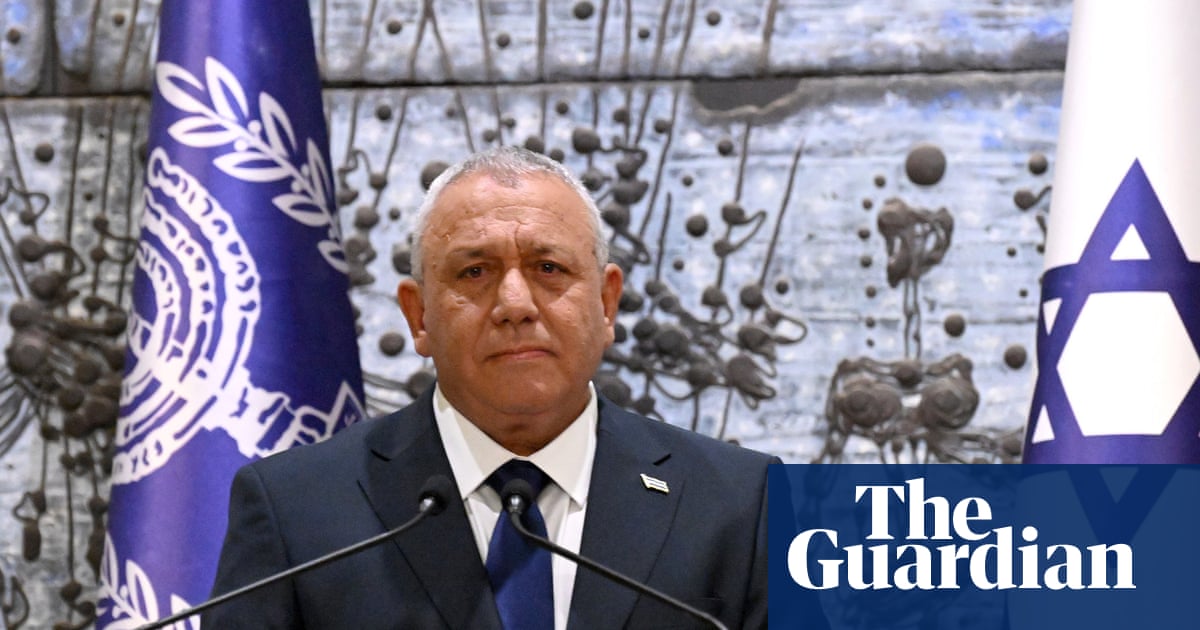
Eisenkot, 66, the leader of the Yashar party, who has vowed to bridge Israel’s deep polarisation under Netanyahu, formally received a mandate from the president, Isaac Herzog, who gave him 28 days to form a government despite his bloc lacking a clear majority.
“We are in a state of emergency, approaching a point of no return for the state of Israel,” said Eisenkot, who had traded his usual all black for a suit and tie, at a ceremony at the presidential office.
“We must form a national emergency government. This will require creative and unconventional political steps.”
Eisenkot faces significant challenges on the road to becoming prime minister. He has three options: a power-sharing agreement with Netanyahu, support from Arab-led parties – something several members of his bloc do not support – or an agreement with the ultra-Orthodox parties, which demand military exemptions for their community.
Both Eisenkot and Herzog acknowledged Israel’s growing isolation under Netanyahu, who is wanted by the international criminal court.
In the US, Israel’s closest ally, Democrats on Tuesday swept the midterm elections, with calls to rein in Israel after the devastation in Gaza and the unpopular Iran war, which Netanyahu launched with Donald Trump.
“We are in the midst of a devastating diplomatic crisis. Even our closest friends and strategic allies are saying their relationship with Israel must be reassessed,” Eisenkot said.
Eisenkot appealed to Netanyahu’s Likud party as well as the far-right party of the finance minister, Bezalel Smotrich, to join – but only with himself as prime minister.
“My door is open and my hand is extended, wholeheartedly and willingly, to anyone who understands the gravity of this moment,” he said.
Should Eisenkot succeed in forming a coalition, he would take over as prime minister from Netanyahu, Israel’s longest-serving premier.
Eisenkot’s wide-ranging opposition bloc won 48 of the Israeli parliament’s 120 seats in the October elections, while Netanyahu’s camp secured 53, leaving neither with a majority.
During party consultations with Herzog, Eisenkot received the endorsements of both Arab-majority lists, who could now play kingmakers after making unprecedented gains in the vote.
He has laid out a series of conditions for any Arab party to join his coalition, including recognition of Israel as a Jewish state and declaring the Palestinian militant group Hamas a terrorist organisation. One of Eisenkot’s partners, the more conservative Yisrael Beiteinu party, has already said it will not join a coalition with Arab-led parties.
Eisenkot, a former army chief, and his partners made equal military service a central part of their campaign. Specifically, they are seeking an end to the longstanding draft exemptions enjoyed by the ultra-Orthodox.
Netanyahu has repeatedly claimed the election was “stolen” by Arab parties, which rallied their supporters to vote in large numbers. But he has offered little to no evidence to support the claims.
Netanyahu is expected to continue his pressure tactics against Eisenkot, saying any alliance with the Arab parties would be an act of betrayal.
Israel’s Shin Bet security agency has launched an investigation into possible foreign interference in the vote, but the country’s Central Elections Committee – and Herzog – say the vote was valid and even if wrongdoing was found, it did not have a significant impact on the result.
Netanyahu called for a “national unity” government with Eisenkot on Saturday night but it remains unclear whether the two rivals could agree on a power-sharing agreement; these types of coalition governments are notoriously fragile and often collapse.
Eisenkot, the military chief of staff from 2015 to 2019, has set out to unite Israelis after Netanyahu’s divisive tenure, under which the country moved sharply to the right.
He has vowed to crack down on extremist West Bank settlers who have attacked Palestinians with impunity, decrying recent incidents as “Jewish terror” abetted by Netanyahu’s government.
But he opposes the creation of a Palestinian state and vowed to end Hamas’s rule in Gaza and destroy the Islamist movement’s military wing.
Commanding the military during the 2006 war with Hezbollah, Eisenkot devised the so-called “Dahiya doctrine”. The idea, named after a Beirut suburb heavily damaged in that war, involves Israel vowing to use massive force against civilian infrastructure in areas controlled by the Lebanese militant movement Hezbollah.
After his appointment, Eisenkot will have 28 days to come up with the 61 votes needed for a government. If he comes up short, Herzog can provide a 14-day extension before he has to offer the mandate to someone else.
If neither side succeeds, Israel will head to fresh elections. The country held five elections between 2019 and 2022 owing to repeated deadlocks.