Country’s fiercest blazes in at least a decade produced toxic smog blamed for 400,000 respiratory infections
Indonesia’s fiercest fires in at least a decade were amplified by an “El Niño that turned off the taps” and “fossil fuels that turned up the heat”, scientists have revealed.
Along with the conversion of forests to plantations, this created the conditions for blazes that have burned almost 3m hectares (7.4m acres) – 19 times the size of Greater London – this year, and cast a choking haze across much of south-east Asia.
An international team of World Weather Attribution scientists analysed the different elements of this triple whammy in Java, Kalimantan and Sumatra to assess how each affected the peak fire season from August to October.
They found global heating, primarily driven by the burning of oil, gas and coal, raised temperatures by 1.6C in this three-month period, drying the land and vegetation.
On top of this, El Niño, which is on course to break all records, added a further 0.3C and reduced rainfall by about 50%.
“El Niño turned off the taps, but fossil fuel emissions turned up the heat,” Prof Friederike Otto, professor of climate science at Imperial College London, said.
“We know that as the world continues to warm, fire weather during El Niño years will become increasingly severe. Without rapidly transitioning away from fossil fuels and strengthened land-management protections, we will see more and much worse fire seasons like this in the future.”
Furthermore, they learned the hot, dry air conditions were made three times more likely by climate change and five times more by El Niño.
Decades of logging, agroforestry expansion and peatland-draining also contributed to the tinderbox conditions.
“Indonesia landscapes have changed dramatically over the last 30 years with extensive pipeline drainage and deforestation creating a landscape that is extremely vulnerable to ignition,” said Pramudhian Firdaus, a meteorologist at Melbourne University, who also works with the Indonesian meteorological service.
Fires continue to burn in Indonesia, because El Niño has helped to delay the rainy season by 20 to 30 days, according to the country’s Meteorology, Climatology and Geophysics Agency (BMKG).
The latest local reports indicate 2.88m hectares have been blackened in Indonesia so far in 2026. If confirmed, this would surpass the record for this century, which was set in 2015 when 2.6m hectares of land was burnt, generating 333m tonnes of carbon emissions.
Fires and drier than usual conditions around the world have contributed to an unusually large rise in the predicted CO2 emissions for 2027, despite a slight fall in pollution from fossil fuels as a result of the US-Israeli attacks on Iran.
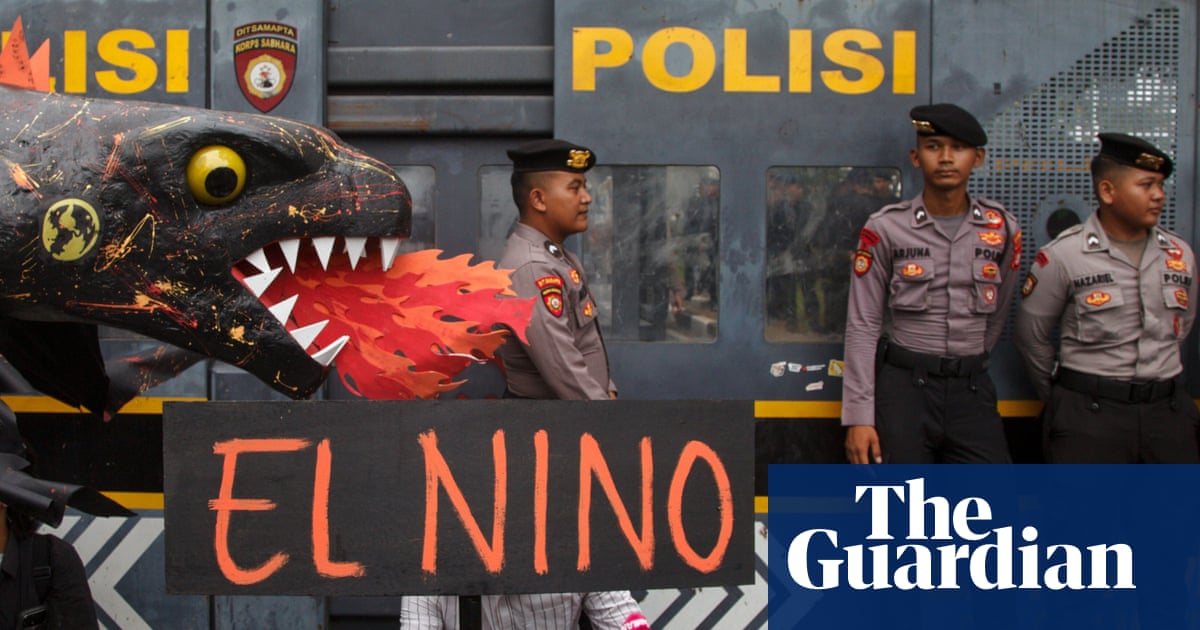
There have also been political implications, with protesters in Jakarta calling for the government to declare the fires a national emergency.
The health effects are still being calculated. Wildfire smoke has choked many cities in Indonesia, with at least 400,000 related respiratory infections, including 180,000 children, according to the health ministry. The toxic smog has spread as far as Singapore, Malaysia and the Philippines.
Maja Vahlberg, technical adviser at the Red Cross Red Crescent Climate Centre, said: “The severe fires in Indonesia are leading to health impacts for people across the region with smoke especially affecting children, older adults and those with pre-existing conditions who tend to be more vulnerable …
“El Niño conditions – even with the extra boost from climate change – are highly predictable, which provides an opportunity for proactive, preventive action to stop future years from having impacts on this scale.”