
Business
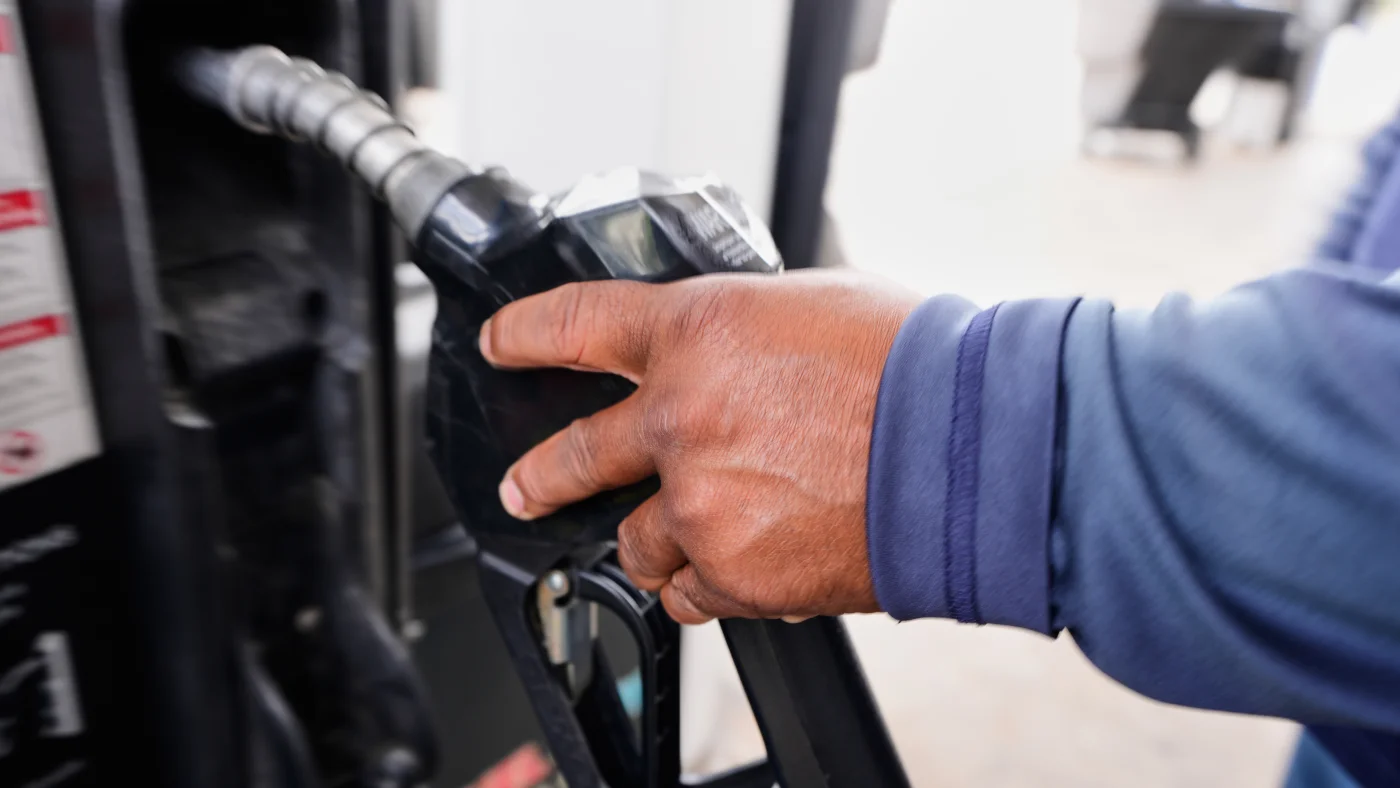
A customer replaces the nozzle on a gasoline pump after making a purchase at Fuel City filling station Friday, April 17, 2026, in Dallas. Tony Gutierrez/AP hide caption
Sign up for the Planet Money newsletter. The world is confusing. Economics can help
Democrats are now poised to take control of Congress by wide margins — and a critical driver of their success has been voter fury about how the war in Iran has driven up the cost of fuel.
Before the war, about one fifth of the world's oil passed through the Strait of Hormuz. As the war throttled that waterway, the price of oil rose: A barrel of Brent crude cost about $70 in late February, spent months hovering around the $110 mark, and is now close to $95.
That's driven up the price of everything that's refined from crude. A gallon of gas costs $4.12 on average — about $1 higher than a year ago. The price of diesel hit a record high in September at $6.52, and while it's fallen a bit since then, a gallon remains about $2.50 higher than this time last year, according to AAA.
Oil company earnings skyrocket — again
Tariffs, diesel and computer chips are driving up costs for automakers
These soaring prices helped major oil companies rake in huge profits over the past two quarters, while making the cost of fuel at the pump uncomfortably high for drivers, and boosting the price of nearly everything in a nation that is heavily reliant on trucking.
So now that the midterm results are in, could drivers see lower gasoline and diesel prices anytime soon?
Not so fast, experts say. Here's why.
What could Democrats do?
Nothing yet — members of the new Congress won't be sworn in until January.
Middle East conflict
Why it's so hard for world leaders to bring down oil and gasoline prices
Why Trump just loosened the rules on 'dyed diesel' — normally a farm fuel
And once they are seated, U.S. legislators have limited powers to directly affect the price of oil, which is dictated by a complex global market.
In the run-up to the election, most of the actions taken by the federal government to lower fuel prices came through the White House, not Congress. Hoping to stave off losses for his party, President Trump tried to ease the cost of diesel by loosening federal rules on dyed diesel, which is normally used for farming. He also announced a deal that would bring more Russian diesel to global markets, including the U.S., by temporarily lifting sanctions. Neither of these did much to move the needle.
But the new Congressional Democrats will have the power to push the president to end the war in Iran, in part by making it harder to authorize new war spending. Senate Minority Leader Chuck Schumer (D.-NY) told reporters on Wednesday that Democrats are intent on ending the war and bringing down the cost of living, saying that "relief is on the way."
"What a unified Democratic Congress can do is make escalation considerably more costly: both chambers can pass resolutions, attach conditions to war spending and hold back confirmations of key officials," Claudio Galimberti, chief economist of Rystad Energy, wrote in a market note to the media.
The Trump administration weakens fuel efficiency standards for new cars
Still, the president has veto power over legislation, as well as executive powers. " President Trump still retains full discretionary authority over military strikes, over blockades and sanctions, licenses, and so on," said Jorge León, head of geopolitical analysis at Rystad Energy, in an interview with NPR.
Trump has sent mixed messages about whether he wants to end or escalate the war. In the past few weeks, he warned Gulf Arab countries to prepare for a new military campaign after the midterms. The U.S. struck Qeshm, an island in the Strait of Hormuz that Iran uses to launch its own strikes, on Nov. 2.
But on election night, Trump told The New York Times that he knew voters were unhappy about gas prices. And the next day, as the extent of the election rout became clear, Vice President JD Vance posted on social media: "The reason we lost is the war."
If the war ends, when would prices fall?
Jaime Brito, executive director of refining and oil markets for Dow Jones Energy, says if there's a deal to end the war, traders could be very excited. Brito said they might look for formal announcements from both Iran and the U.S. that the strait is reopening, and that both sides are pulling back their military presence in the area.
The U.S. Strategic Petroleum Reserve is low. Here's why you should care
If market traders are convinced the peace will last? "If that scenario happens, then I personally see crude prices dropping, you know, $15, $20 [a barrel] immediately, in the next two, three days from the announcement," he said.
But for gasoline and diesel prices to fall, too, oil would have to start moving again. Ships that have been running long, alternative routes to avoid passing through the Strait of Hormuz would have to return to their points of origin, and then resume their former routes through the strait. León pointed out, that could lead to traffic jams.
From there, that crude will still need to be refined and make its way onto the market.
In the most optimistic scenario, Brito said, it could take three months after a ceasefire or deal is announced for gasoline and diesel prices to hit their prewar levels.
León thinks it would take more like six months for the price of crude to hit its prewar level, and then another month or two for gasoline and diesel to follow. But that's assuming all goes well. And, both of them said, there could be hiccups along the way that stretch the recovery timeline out for up to a year after a deal is announced.
" I don't want to say this, but, you know, expensive gasoline prices could be a new normal," Brito said."
The X factors
Europe
Ukraine resumes attacks on Russian oil refineries, officials say, after brief truce
The first big X factor: the war in Ukraine.
If Ukraine continues attacking Russian refineries, the price of diesel may not drop as precipitously as gasoline might. That's because Russia's refineries normally bring much of the world's diesel to global markets. Resuming traffic through the Strait of Hormuz will help lower the price of diesel — but it may take longer to reach its prewar level, León said.
Other scenarios could make for a less rosy picture, León said. U.S. refineries have been running above 90% capacity — what if they need emergency maintenance just at the moment when there's more oil ready to bring to market? Or, what if hostilities restart again, despite a deal?
Brito agreed. Before the end of the year, there could theoretically be new attacks in the strait, he wrote, "if the current administration sees it as a 'window' to complete unfinished tasks before the new Congressional layout takes their seat in January."
And there's also one more factor at play: The war has raised the price of moving oil itself around the world.
Since the Strait of Hormuz has been blocked off for so long, freight costs have gone up; ships carrying oil have had to skirt around the strait, take longer routes and use more fuel in the process. Plus, the price of insuring those ships has gone up, since transit around the strait has gotten so much riskier.
That means that even the oil industry is paying more to be in the oil business. And if hostilities persist and those freight costs remain high, that could keep the price of Brent crude elevated for longer.
"Bottom line," Brito wrote, for any hope of a return to normal prices, "you need to see a definitive end of the conflict."
NPR does not offer or accept money for coverage or interviews. Anyone who makes such an offer or request is not an NPR employee and does not represent NPR.


