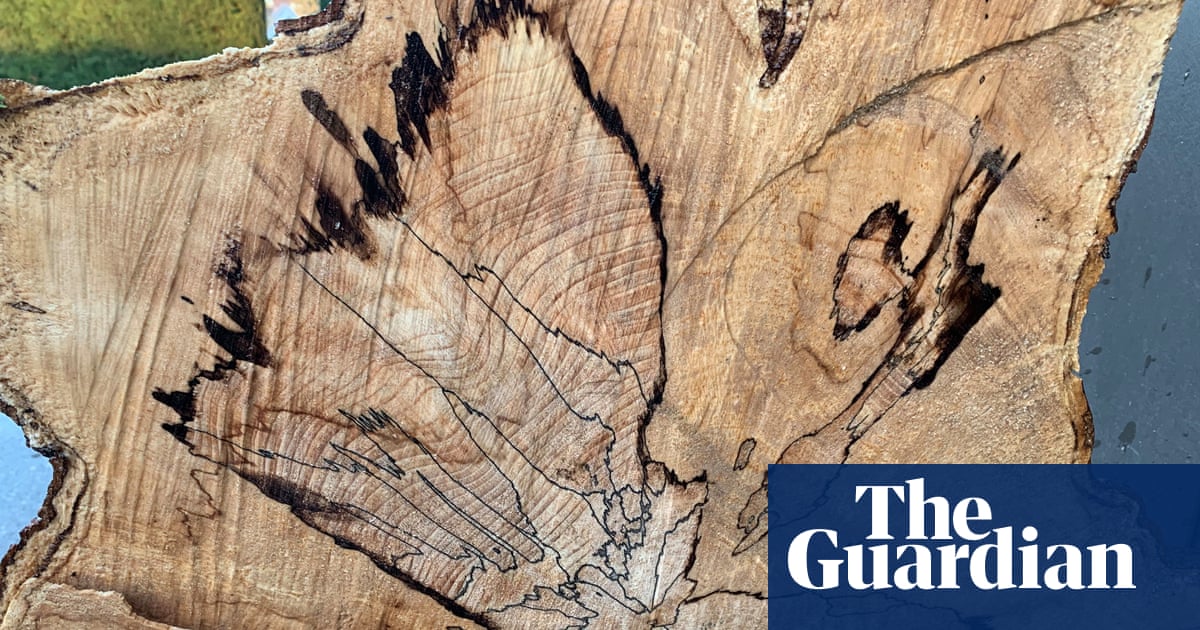
Caistor St Edmund, Norfolk: The woodland floor is littered with sycamore and ash, some revealing a pattern that runs through trunks like words in a stick of rock
An ash tree swayed, audibly groaning, a split in the trunk opening and closing like a mouth. Suffering from ash dieback, it seemed it could topple at any second here in the quiet of the woodland. A few weeks ago, Dad set the trail camera on it, to capture the moment of fall. Since then, two storms have churned through Norfolk – treating us gently compared with elsewhere, but nevertheless leaving casualties in their wake.
Fallen trunks now crisscross the woodland floor: sycamores, several ashes, an oak. But not the ash that had seemed so vulnerable. Why does one tree survive but another fall? I look closely at one of the ashes that succumbed to the winds, with its headless trunk jutting skyward, spiked and bare.
This ash’s secrets are exposed now. It was completely hollow, and within the cavity, now ripped open, grows fungi: golden scalycap and honey fungus. Where the bark is torn away, I find the black rhizomorphs of the honey fungus, also known as bootlace fungus. These tendrils creep along unseen like something from Stranger Things, spreading underground from tree to tree. When the rhizomorphs reach a root, the fungus grows beneath the bark and rots it, slowly killing the tree.
If two different fungi colonise the same piece of wood, they compete for territory. Like warring factions, each establishes a boundary, sealing off its patch with darkly pigmented fungal threads, known as melanised hyphae. It creates an intricate map of their battle.
This ink-dark patterning is called spalting. While hated by the timber industry as a sign of weak, compromised wood, it is prized by craftspeople and furniture makers. I have a beautiful wooden bowl made by a wood turner out of spalted wood. The lines bring unique variation and character, transforming it into a piece of art.
Dad is supposed to be banned from chainsaw use – blood thinners and power tools don’t mix – but he cut up a spalted ash trunk. Like writing through a stick of rock, the trunk is illustrated by spalting throughout, the markings like the veins on a butterfly’s wing. The giant, damaged ash sways on – for now.