Report led by Peter Garrett and former defence chief Adm Chris Barrie says agreement should be suspended and calls for royal commission
Get our daily political email, free app or daily news podcast
A public inquiry into the $368bn Aukus nuclear submarine agreement has called the plan “the worst, riskiest and most costly defence decision ever made by an Australian government”, urging its immediate termination.
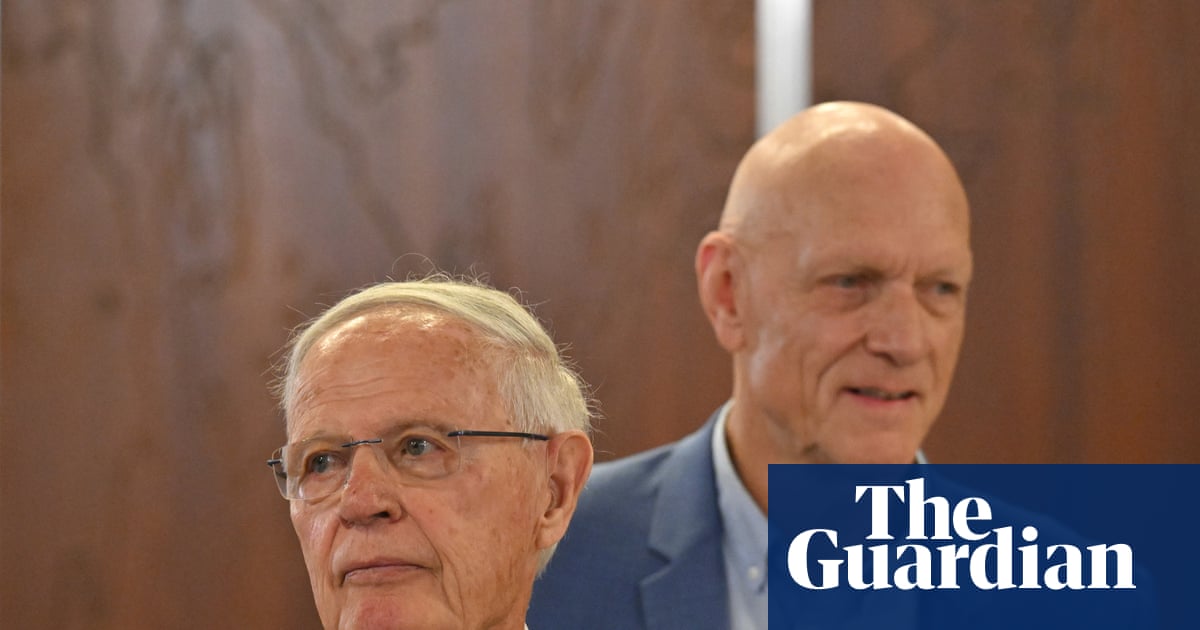
Former Labor MP and Midnight Oil frontman Peter Garrett, alongside former chief of defence Adm Chris Barrie, led the inquiry dominated by critics of the deal with the UK and US, recommending the suspension of plans for new bases and for a royal commission to be held into the agreement signed by the former Morrison government.
Its report, titled Surrendering Australia: the Aukus Deception, says Australia risks being dragged into military conflict with China because of the presence of powerful nuclear submarines. Aukus badly undermines Australia’s sovereignty and undercuts longstanding commitments to nuclear non-proliferation, it says.
The inquiry report, released on Wednesday, was downloaded nearly 15,000 times within an hour of being published online.
The report calls for a rework of the second pillar of the agreement, which covers technology and defence capability sharing, and for a fundamental recalibration of Australia’s relationship with Beijing.
Sign up for Guardian Australia’s Politics, really newsletter here
After hearings around the country and more than 1,000 public submissions, the inquiry highlighted a lack of scrutiny and oversight over the five years since Aukus was announced and called for the auditor general and federal parliament to launch independent reviews.
“Since coming to power, Labor has failed to conduct a thorough review of this most significant of defence agreements,” Garrett told the National Press Club in Canberra.
“Conceived in secret, Aukus has spurned established defence and parliamentary oversight practices.”
He said the Stirling defence precinct in Perth risked becoming a “de facto US base” hosting as many as 2,000 serving American personnel, and that nearby communities including Rockingham and Fremantle would become targets for attack.
“The Aukus submarine plan is not tenable,” Barrie, who served as chief of defence between 1998 and 2002, said.
“It’s time for our government to take the lead on this matter. Scrap the Aukus submarine plan now, and rebuild national security decision-making processes.”
Labor agreed to support the deal for Australia to acquire nuclear submarines, which was negotiated under Morrison, then US president Joe Biden and UK prime minister Boris Johnson. As part of the agreement, Australia is funding upgrades to the US defence industrial base and is due to start receiving secondhand Virginia class nuclear submarines around 2032.
But delays and cost blowouts for production of submarines for the US navy have led to scepticism that Australia will receive the in-service boats.
The UK parliament held a year-long review and, after an inquiry by the Pentagon in 2025, Donald Trump agreed to support Aukus.
But former prime ministers Paul Keating and Malcolm Turnbull, former foreign affairs ministers Gareth Evans and Bob Carr, environmental and security campaigners, and some within Labor believe Aukus is not in Australia’s national interest.
Frustrated by the lack of scrutiny – in part due to bipartisan support for Aukus in federal parliament – unions, not-for-profits and former officeholders launched their own inquiry backed by public donations totalling $220,000.
Labor argues Aukus was considered as part of the government’s defence strategic review.
Government ministers have dismissed the public inquiry as a stitch-up by critics of the agreement. A spokesperson for the defence minister, Richard Marles, said on Wednesday that Aukus is a core pillar of the Albanese government’s national security policy.
“As the national defence strategy 2026 re-confirms, we confront the most challenging strategic circumstances since the second world war, and we do so at a time where Australia’s economic connection with the world has never been greater,” they said.
“We need to support the development of an ADF with a much greater capacity to project so we can defend Australia and contribute to regional security and stability.”
Garrett warned any certainty the US president would eventually agree to send submarines to Australia could not be guaranteed.
“There are no refunds, no enforceable obligations on partner countries, and no recourse if things go wrong,” he said.
The inquiry estimates an additional $180bn will be needed to deal with nuclear waste generated by Aukus, based on evidence to the inquiry. No official cost estimates for waste have been published.
Australia has not identified a permanent storage site for the waste, including the high-level radioactive waste from the reactor core and spent fuel, which will remain toxic for thousands of years.
The government’s preferred measure of the total cost of the deal is 0.15% of GDP over its lifetime.
The first Virginia-class nuclear sub from the US is due to arrive in Australia in 2032, with another arriving every four years, before the Australian-built model is ready for operations. The bespoke SSN Aukus model is due to come online in 2042. Campaign group Labor Against War welcomed the report.
“With rising cost of living and unemployment, spiralling inflation and interest rates, it is beyond comprehension why the Australian government is throwing billions into the war chests of the US military at a time when the Australian people are crying out for solutions at home,” the group’s patron and a former senator, Doug Cameron, said.