
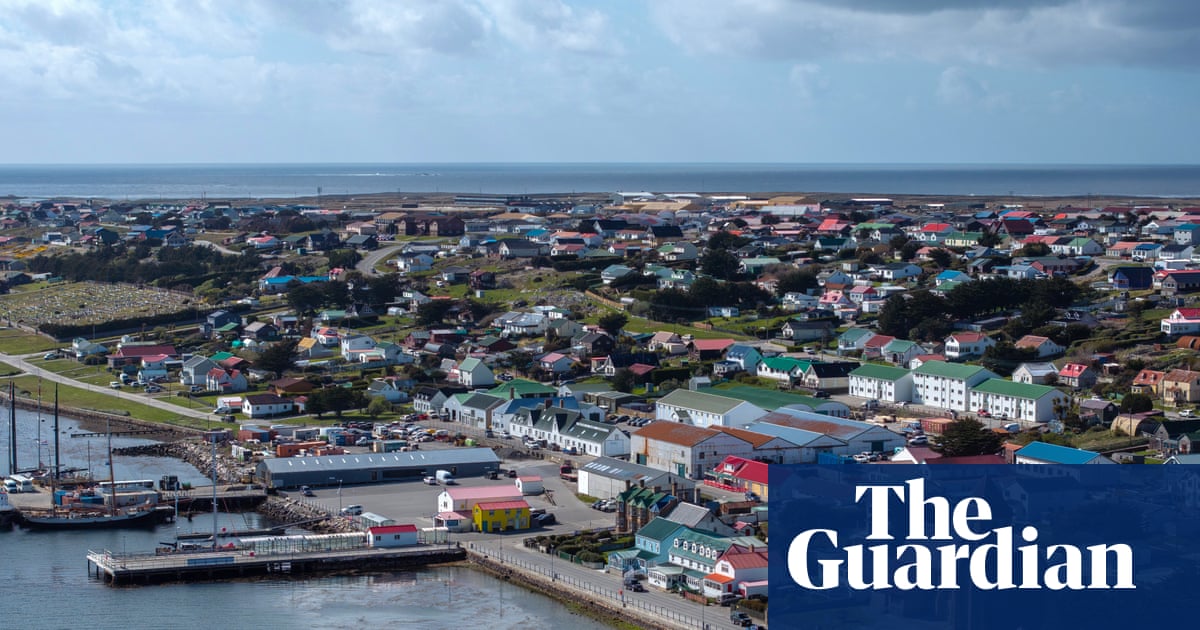
Exclusive: Legal notice comes as Buenos Aires ramps up rhetoric over UK territory and seeks to halt Sea Lion project
The Argentinian government threatened a British businessman involved in an offshore Falkland Islands oil project with jail, the Guardian can reveal.
Sam Moody, the chief executive of Rockhopper Exploration, and his company’s chief financial officer received the correspondence this autumn as Buenos Aires began ramping up its rhetoric over the British overseas territory.
“As recently as 1 September 2026, Argentina wrote to me and Rockhopper’s chief financial officer personally threatening us with criminal prosecution, imprisonment and fines under its domestic legislation,” Moody said.
The disclosure was made in a witness statement submitted by the UK to the international tribunal for the law of the sea (Itlos) before two days of hearings that were held this week. The sealed document was made available for viewing after an application by the Guardian.
Argentina is seeking an order from Itlos for the urgent suspension of drilling at the Sea Lion offshore oil project north of the Falklands, which is being led by Rockhopper, a British firm, and Navitas, an Israeli company.
Buenos Aires has passed domestic legislation criminalising the project and in Moody’s statement to the tribunal, the oil executive also said he believed there was a risk in him engaging with the hearing in Hamburg.
“I also want the tribunal to be aware that I, in common with others, [am] taking some personal risk by preparing the statement as I have repeatedly been under threat of criminal prosecution and a custodial sentence in Argentina,” he wrote.
Moody’s submission listed a series of other actions taken by Buenos Aires that he said had made it increasingly difficult to finance Sea Lion. They included Argentina banning Navitas from operating in the country for 20 years.
It is also claimed that Argentinian officials wrote to Standard Chartered bank, which has a branch in Port Stanley, the capital on the Falklands, urging it to “refrain from participating in oil and gas development in the Falkland Islands to avoid falling within the terms of certain Argentine domestic legislation”.
In a further submission to the tribunal, it emerged that Navitas and Rockhopper had not named their partners in court documents for fear that they would be subject to Argentinian retribution.
“The names of the contractors engaged by Navitas UK have been witheld to preserve their confidentiality in light of the ongoing scrutiny by Argentine authorities and their ongoing efforts to frustrate the project, including through purported actions directed at contractors and partners involved in the project,” according to a submission made by Ian Ramsay, chief executive of Navitas Petroleum Development and Production.
The US firm Halliburton recently issued a statement in which it said it would not conduct any work on the Sea Lion project after discussions with Argentina.
Last month, the Guardian revealed that the UK government had written to Interpol seeking reassurance that the international law enforcement agency would not act on any Argentinian “red notices” requesting the arrest of those deemed criminal by Buenos Aires for their involvement in the Falklands economy.
Argentina’s application for suspension of the Sea Lion project is based on the claim that Britain’s agreement to drilling is illegal as the sovereignty of the Falkland Islands is a matter of dispute between the UK and Argentina.
In 1976, a UN resolution called for the two countries to settle their rival sovereignty claims and to refrain from acting unilaterally to modify the situation in the Falklands. Argentina seeks a temporary suspension of the project before further arbitration, claiming that the oil drilling is “aggravating” the sovereignty dispute.
In response, the UK claimed this week that the tribunal did not have jurisdiction in the dispute and that the UN resolution cited was not legally binding. Ellie Reeves, the attorney general for England and Wales, further told the tribunal that the oil project’s suspension would be terminal to its hopes of success with “devastating consequences” for the people on the islands.
The Sea Lion project is expected to double the island’s GDP, providing an £8bn uplift in revenues of the Falkland government over the oilfield’s active lifetime.
In a further submission to Itlos, Jack Ford, a member and the current chair of the Falkland Islands’ legislative assembly, told the tribunal that the impact of the collapse of the Sea Lion project would “not just be economic but also social, and felt across the whole of the Falkland Islands”.
In September, Argentina’s president, Javier Milei, told the UN’s general assembly that reclaiming the sovereignty of the Falklands, known as the Malvinas in Argentina, was a national cause and that Buenos Aires was taking “matters into our own hands” through peaceful means.
Argentina invaded the Falklands in 1982. The 74-day war ended with the surrender of the Argentinian forces. It cost the lives of 649 Argentinian military personnel, 255 British military personnel and three Falkland islanders.
A ruling by Itlos on Argentina’s application is expected on 28 November.