As Rome prepares to celebrate 400 years of St Peter’s Basilica, a prized collection of artefacts acquired by Catholic missionaries is staying out of the spotlight. We take a closer look
In the four-hour queue to get into the Vatican Museums last week, everyone around me was fixed on seeing the Sistine Chapel. A couple of people mentioned the Raphael rooms, and someone else was looking forward to the classical sculpture of Apollo. But no one else was headed where I was going: the Anima Mundi, formerly the Ethnological Museum, home to around 80,000 objects from across the globe, many of which were “gifted” to the Catholic church in Rome by Indigenous peoples at a time when its missionaries were powerful, and sometimes dubious, figures in their far-flung communities.
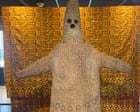
The collection is housed a few steps inside the main door of the Vatican Museums, in a basement: and, sure enough, on the day I visit, it’s almost empty. Not for want of fascinating objects: among the items on display are handsome balsa wood carvings made by the Emberá people of Panama and Colombia, each representing protective and ancestral spirits; a crocodile figure from Papua New Guinea, believed to represent the creator of all things; and sculptures from central Africa denoting dead children (mothers would care for them, because they were believed to retain the spirit of the deceased offspring).
The collection covers pieces from Australia, the Americas, Africa and Asia, including the oldest item in the entire Vatican Museums, a two million-year-old stone chopping tool from South Africa, one of the oldest-known deliberately made objects. There are carved grave posts from Madagascar, a reliquary from Polynesia, and an Aztec carving of Quetzalcoatl, the multi-faceted serpent deity.
The origins of this collection lie in an event mounted in 1925, when Pope Pius XI asked Catholic missionaries around the world to send cultural and sacred belongings from the communities they “served” to Rome, for an exhibition that would celebrate the Catholic church’s reach across the planet. It went on for a year, was attended by around a million people, and when it finished many of the objects remained in Rome. The following year, in November 1926, they became the core of a new Vatican Ethnological Museum, then housed at the Lateran Palace. In 1973 it moved across Rome to the Vatican Museums, where it remains to this day.
They’re big on anniversaries at the Vatican – witness the huge service planned next week to celebrate 400 years since the consecration of St Peter’s Basilica – but there’s an eerie silence round the Ethnological Museum, rebranded the Anima Mundi (“soul of the world”) in 2019. A source inside the Vatican told me a decision had been made to lie low over this particular landmark.
The reason for that could well be growing disquiet around the morality of holding this collection at the heart of Catholicism. A hundred years ago was a different era, and the church’s missionaries were powerful figures in communities with little political or economic clout. How sure can anyone be that meaningful belongings holding great significance were handed over willingly to priests who wielded such power?
Professor Gloria Bell, an art historian at McGill University in Montreal, and author of Eternal Sovereigns: Indigenous Artists, Activists, and Travelers Reframing Rome, calls the Anima Mundi “an unsettling colonial collection”, and says she has seen evidence that missionaries “looted graves in Canada” to gather exhibits for the 1925 exhibition. She says the idea that everything was gifted is “a false narrative. These are cultural belongings, not artefacts. They are ancestors and when they were removed, connections were severed,” she says. The Vatican declined to be interviewed for this piece.
As you go into the museum there’s what Bell calls a large trophy case. “Missionaries described Indigenous ancestors as the pope’s trophies in the 1925 exhibition and, to this day, that visual equation is being made in the museum.”
Bell, herself descended from the Métis people of Canada, also sees a failure to put the collection into its proper context by providing explanation of how missionaries worked. “Neither the wall texts nor the catalogue explore the complexities around how the missionaries operated. The ongoing harm that missionaries inflicted on Indigenous peoples through their genocidal missions operating in First Nations, Métis and Inuit communities across Turtle Island [an Indigenous term for Earth] is not acknowledged at all.”
Bell says there are many question marks over the provenance of the collection, and more restitution work needs to be done. Some objects have been returned – including three Peruvian mummies, repatriated in 2022, and an Inuvialuit kayak and 61 other items which were returned to Canada last year, three years after Pope Francis apologised to Canadian First Nation people for the church’s role in the genocide and suppression of Indigenous identity through the residential schools programme.
For Bell, this is the tip of the iceberg as far as repatriations are concerned. “That was one small step, but a lot more needs to shift,” she says. “I’d like to think that as an American pope, who worked for many years as a missionary in Peru, Pope Leo XIV might be more aware of these issues.”
As a sovereign state, the Vatican is only subject to its own laws: but in the US, for example, the Native American Graves Protection and Repatriation Act of 1990 established a pathway for museums to return items to descendants of Native American communities.
Even in 1925 some people questioned the ethics of the exhibition: most notably Anthony Martin Fernando, an Australian Aboriginal who had travelled to Europe to protest at the treatment of his people, and who went to Rome to leaflet visitors to the 1925 ethnological exhibition. Like many of those who have asked questions about the Vatican collection – including Pope Francis – Fernando was a committed Catholic.
As far as Bell is concerned, this month’s anniversary should be a turning-point in the museum’s history. “The 1925 exhibition, and the museum that grew out of it, is a monument to papal greed,” she says. “Pope Leo XIV could change things: he could, and he should, act.”