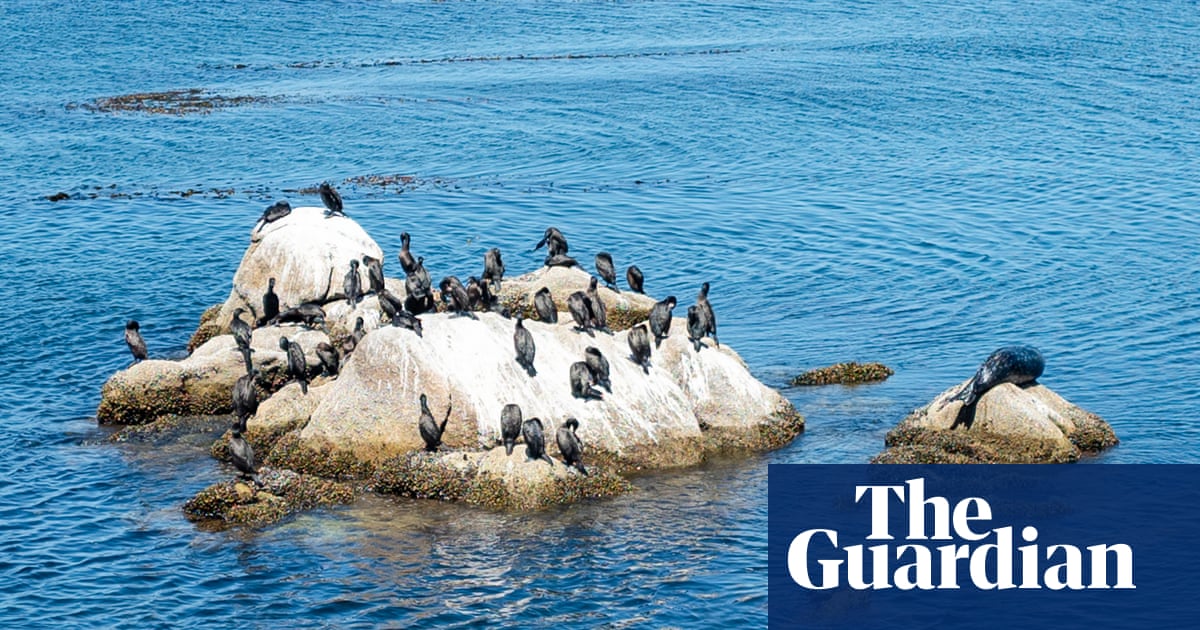
Water temperatures are climbing the charts, high tides are swallowing the shoreline and vital parts of the food web that feed ocean diversity are disappearing
On a picturesque autumn afternoon last week, the beaches of California’s Monterey Bay were teeming with life and death.
A cadre of shorebirds charged and retreated in a synchronized dance with the raging surf. Nearby, the receding tides had deposited lifeless bundles of feathers and bone, tangled in piles of glistening kelp. Swollen sea lion carcasses, their teeth bared in a quiet grimace, dotted the sand as beach picnickers and dog walkers enjoyed the warm, cloudless day.
The effects of a historic El Niño have officially reached Monterey Bay, according to scientists, and the mortality on display here may be a grim harbinger of more to come. The waters that hug California’s central coast are already undergoing startling changes.
The climate phenomenon, defined by unusually warm equatorial ocean conditions, is rapidly heating and expanding parts of the Pacific. Water temperatures are climbing off the charts, from the ocean’s depths to its surface. Record-smashing high tides are swallowing more of the shoreline. Plus, vital parts of a vibrant food web that feeds ocean diversity are disappearing, starving scores of species throughout the system.
These changes are compounding the impacts from the climate crisis and extreme marine heatwaves that have already stressed ocean ecosystems and their inhabitants.
“It is like nothing we’ve ever seen,” said Dr Jono Wilson, the science director for The Nature Conservancy’s oceans program. “We just are trying to figure out how to wrap our heads around the sheer scale of this event.”
Visual reports from divers, underwater cameras, and beach-goers have showcased how deeply underwater environments are changing. Waters clouded with nutrients cleared as they warmed, and an unusual array of visitors arrived from the southern seas.
The central coast has played host to schools of halfmoon fish that ventured far past their southern California range, translucent winged comb jellyfish generally spotted on dives near Hawaii, and Humboldt squid that are usually found in the eastern equatorial Pacific. Whale sharks common in the Sea of Cortez were seen in Malibu and juvenile garibaldi fish – brilliantly orange speckled with glowing electric blue splotches – were seen for the first time in Monterey Bay.
Despite the visible impacts near the shore, El Niño anomalies are even easier to spot at depth. A buoy moored at the mouth of Monterey Bay laced with sensors has been providing scientists like Dr Francisco Chavez, a senior scientist who leads the biological oceanography group for the Monterey Bay Aquarium Research Institute (MBARI), with insights from farther below.
Temperatures in the ocean layer called the thermocline, which acts sort of like a transition space between the sunlight-filled surface and the dark deep ocean, have been steadily rising in recent months. Chavez said they’ve now reached 8C (46.4F) above average. That rivals what is being observed at the equator, where El Niño signals tend to be the strongest.
Researchers had to add more height to their graphs to accommodate how sharply the heat has risen. “It’s almost at room temperature 200ft below the surface,” said Dr Henry Ruhl, director of an ocean observing collaboration housed at MBARI. Meanwhile, scientists watched as important phytoplankton populations plummeted alongside the rising temperatures.
It’s not unusual for the waters to become less productive in winter, but the change was pronounced. “That’s a real indicator of the amount of biomass that’s there to supply marine food webs,” Ruhl said, adding that it dropped by an order of magnitude.
Warm water with fewer nutrients has had a pointed effect on kelp forests, essential ecosystems along the California coast that are still suffering from the last strong El Niño roughly a decade ago.
“Kelp is the key foundation species and it enhances the whole biodiversity of the system,” said Dr Scott Hamilton, a professor at San Jose State University and director at the Moss Landing Marine Laboratories just north of Monterey Bay. “We know when you lose the kelp, you can lose about 40% of the species that live in the kelp forest.”
The kelp is very sensitive to abrupt changes in its environment. Warm waters, fewer nutrients, and big wave events are all disruptive. During El Niño years, these are more likely to occur – sometimes all at once.
“We lost a lot of kelp just because the temperatures are just so crazy warm,” Hamilton said, adding that the air temperatures were cooler than the water. The kelp held on at first, but as the water warmed, it began to disintegrate and die off. “Last week, a lot of it just kind of melted,” Hamilton said.
When the kelp forest takes a hit, it’s like the first domino falling to set off a cascade of effects. And once the kelp is in decline, it has a much harder time bouncing back. Hungry sea urchins, deprived of their normal levels of nutrients, “start actively grazing around like little lawn mowers on the reef – any little baby kelp that pops up, they just mow it down”, Hamilton said. “That then keeps this very sort of food-limited system and no habitat for species, and it can perpetuate itself for long periods of time.”
Warm temperatures drive fish deeper into the ocean
Rising temperatures are also upending the food chain on the ocean’s surface and shore. Starved or starving seabirds have washed ashore between San Francisco and Los Angeles by the hundreds over the last few months.
Scientists believe that warming temperatures are driving the fish these birds depend on into deeper waters, but the exact cause of the mass mortality will take time to understand. Experts are afraid this may just be the beginning of an exceptionally challenging winter.
Brown pelicans and Brandt’s cormorants are being heavily impacted, and common murres have been among the hardest hit. The tuxedoed seabirds that resemble penguins and are related to puffins struggled in warming conditions even before El Niño conditions began to drive their food sources deeper. Marine heatwaves have had catastrophic impacts on their populations before.
During another exceptionally warm period between the summer of 2015 and spring of 2016, roughly 62,000 dead or dying murres were found on beaches stretching from California to Alaska, during a mass-mortality event that would ultimately claim an estimated loss of 4 million birds.
“We have already seen a lot of murres along the beaches,” Chavez said. “The fish they feed on are moving deeper.”
Experts won’t be able to track the full-scale impacts on these populations and many other species until next spring. Between now and then, Chavez said, it’s still hard to predict how events will unfold. But excessive warmth isn’t expected to fall off much over the next few months and that alone could wreak havoc on a variety of species, including fish, mammals, and birds. “Some will move,” he said, “and some will perish”.
Back at the Monterey Bay, Kriss Neuman pointed her foot at a pile of kelp – a large tangle of wobbly brown ribbons and bulbs lying limp on the beach – momentarily disbanding a cascade of tiny black flies, as she quickly jotted observations on to a clipboard.
As a principal ecologist for the scientific conservation organization Point Blue, Neuman’s research primarily focuses on the Pacific population of western snowy plovers – tiny tufts of white that speed across the sand on stilted legs or blend into the dunes.
Charting changes and impacts to their populations, which are federally protected under the Endangered Species Act, sometimes means counting the fresh piles of kelp on which they indirectly depend. “Kelp not only has this amazing productive life when it’s in the ocean – it has a second life when it comes to shore,” Neuman said.
Invertebrates and insects that come with the kelp or eat it when it’s on the sand feed the birds. “But it’s not enough to just have kelp in the system,” Neuman added. “There has to be a beach that is wide enough and high enough. In order to receive that kelp and for it to persist and kind of fire up the sandy beach food chain.”
The dueling challenges come to a head in El Niño years, as temperatures and nutrient declines take out the kelp forest and sea level rise chews away at the shrinking shoreline. But there’s a third element that could wreak havoc on bird populations that depend on the beaches: an issue Neuman refers to as “coastal squeeze”.
The coast has been armored with seawalls, steep berms, and other forms of protective hardscape added as cities and communities try to keep the rising tides from swallowing infrastructure. This has a negative impact on sandy beach ecology, which is also getting hammered by strong surf.
As their habitats get squeezed, “we expect to have fewer birds, less kelp on beaches driving the food web, and really narrow beaches,” Neuman said. “The predictions for sandy beach loss in California are pretty dire.”
‘There is still hope to save at least some of them’
Just north of the beaches, a small room lined with petri dishes, beakers, and buckets – and emitting a strong briny smell – may be the key to softening some of the threats to California’s coastal ecosystems.
Moss Landing Marine Laboratories research technician Bennett Bugbee held up a glass jar swirling with soft, small green kelp spores. Contained within them is the future of the food web.
Hundreds of plants could be grown from what’s in one little beaker, according to Bugbee. “And there are – what – thirty beakers on this table? So, there’s a lot of kelp we have at our disposal.”
As they grow, the kelp is moved from their beakers to tanks. Once they get about 4 to 6in long, they are relocated to basins outside near the shoreline so they can adapt under more variable conditions. For the final step, they are woven into ropes rigged to PVC pipes and placed in the ocean.
Even with careful cultivation in the lab, El Niño is adding obstacles to the process. Seawater the team pipes in for their tanks is becoming far too warm – Bugbee described it as feeling “like bathwater”. They are also having to think about how to move the tanks now housed near the shore farther inland if the tides continue to rise.
Even with the challenges ahead, Bugbee is cautiously optimistic. “Because we’ve been out there doing the work, seeing what’s going on, we’ve been able to adapt with the changing conditions,” he said. “ I think there is still hope to save at least some of them.”
The restoration process has already had successes. Kelp forests were decimated during the last El Niño, especially in the northern parts of California dominated by a species called bull kelp, of which more than 90% has been lost. “But there are some areas that have persisted,” Bugbee said of the work to rehabilitate the essential plant. “Just last year at our restoration site we had over 700% increase in kelp canopy, relative to control sites.”
It’s not just the kelp that could be spared the worst outcomes. Scientists in a range of fields are working diligently to build resilience into the most at-risk systems. Their findings will also add insights for how to protect communities on land and sea as the world continues to warm.
Research done during previous strong El Niño events and other marine heatwaves has provided a head start. “For the past 10 years, we have just been doing an incredible amount of work to prepare California and the West Coast for future El Niño’s and we’re at a much better spot right now,” Wilson said. “We have a lot of the tools and resources at the ready to help us recover.”