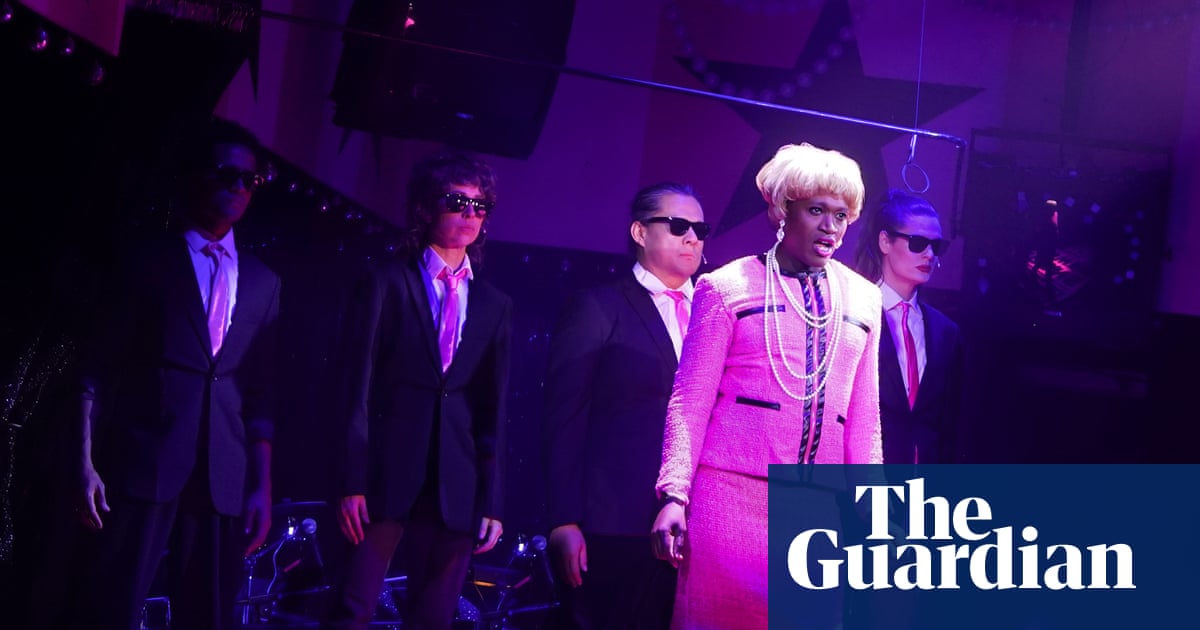
In off-Broadway show Ms Blakk for President, Oscar-winning Moonlight writer Tarell Alvin McCraney explores a slice of under-appreciated queer history
At the height of the Aids crisis, Chicago activist Terence Alan Smith put on his drag persona, Joan Jett Blakk, and announced she was running for president. Her slogan: “Lick Bush in ‘92!” Her platform: fire everyone in the White House and paint it pink, reroute the military budget towards education and healthcare, then give the land back to Indigenous people “and let them take it from there”.
The campaign did not advance. But Blakk did make it on to the floor of the Democratic national convention by infiltrating Madison Square Garden (as Smith) and changing in the bathroom. The country saw its first Black drag queen presidential candidate.
This month, theatremakers Tina Landau and Tarell Alvin McCraney have unveiled the New York premiere of Ms Blakk for President, a kaleidoscopic look at Smith’s life and activism with a set inspired by underground 90s nightclubs.
The piece came together in 2019, when Landau was scheduled to direct another of McCraney’s plays for Chicago’s Steppenwolf theatre company, but casting fell through. (McCraney is best known as the Oscar-winning screenwriter of Moonlight, which he adapted from a previous work.) Landau had directed McCraney years earlier, in 2004, and was “dead-set on having Tarell act in something”, whatever that might be.
With a tight deadline to fill the sudden programming slot, Landau said she was “literally flipping through a book on Chicago LGBTQ+ history and came across one tiny paragraph about Joan Jett Black. I stood up from my desk and pointed at the book, saying out loud: ‘That’s it.’”
The two set about to find Smith, which Landau says “took a bit of a while”. Smith had moved to San Francisco, where he campaigned for mayor and became an underground arts fixture. When they finally got to him, he’d been unhoused, moving between friends’ apartments for some time. Landau flew out to get his blessing and insight, and the two “holed up in a hotel room for some days” for an extensive interview.
“The main thing was how shocked he was that we had found him, and that we were interested in telling his story,” she recalls. “He could not get over – until the second we opened in Chicago and he was there – that someone remembered and found it significant, and was making it a part of our larger queer history and memory. He felt he had been lost and forgotten.”
McCraney had been familiar with drag, but learning about Smith “opened up a whole other channel of drag-as-activism that I didn’t know about, not to the extent of the lineage of genderfuck that Terence was engaging in”. Smith showed “no pushback” against drag’s mainstreaming in the intervening years, McCraney says, even cheering on “some of the older queens who were on RuPaul’s Drag Race”.
“But he talked about the ways in which his and others’ approach to drag hadn’t exploded and become the commercialized version,” McCraney says. “Terence was never going for realness, he was going for something where he would be in a dress and didn’t tuck, or hide the fact the wigs didn’t fit. He was saying: ‘Sometimes I put on a dress and this other part of me comes forward.’”
Blakk’s campaign was centered on intervention more than election or perfection. In a video for Queer Nation, the activist organization on whose ticket she ran, Blakk beams that presidential campaigns are “performance art … nothing but orchestrated, rehearsed musical numbers, so we can just blend the two”.
Smith appealed to Landau because “he wasn’t saying he was inventing this new thing of: ‘Pay attention to me and I’ll make a point.’ He was exposing something he felt was true of all politicians.” She says their conversations “were a trip because it wasn’t an interview – it was just him”.
For McCraney, those recordings felt like “very theatrical, very queer modes of performance in order to get at one thing”. The play, he hopes, is designed not to be a straightforward account of his life but a reflection of Smith’s free-wheeling raconteurship, and of what his activism could inspire in others.
“I grew up doing outreach theater on the streets in Miami, where you would call attention and then be like: ‘Don’t do drugs,’” McCraney says. “Terence and friends would put on wigs and dresses and run around the park with condoms and leaflets and do a whole show and get people to sign up for things. They took it to another level with guerrilla tactics to get information out there.”
Rather than a traditional narrative, McCraney here strives for audiences “to feel how this activation starts: how you can take the things that are right in front of you and turn it into the kind of activism you need, brick by brick. That felt more true to the way Terence revealed these stories to us than trying to put it in a living room and talking about it.”
He and Landau have made substantial edits since its Chicago premiere, where it opened with Blakk’s campaign launch. Now, Landau says, “that scene happens about halfway in, so there’s an entire half of a play that was not included before, including how and when she chose the name Joan Jett Blakk.”
“It feels more like an origin story for a hero,” McCraney adds. “We watch the birth of this person who has this amazing ability to charm the shit out of people. It’s not that we’d missed the mark but, over time, I’ve become more enamored with Terence, the storyteller. We wanted to make sure that we all leave knowing there’s a little bit of that in all of us.”
McCraney performed the role in Chicago, and Wayne Brady was meant to debut the character in New York until a vocal polyp interfered. Tony-nominee Ato Blankson-Wood will now be stepping into Ms Blakk’s high heels, which he readily slipped on without realizing they once belonged to a real person.
“Learning that this was based on someone’s life has helped me be in service of something,” Blankson-Wood says. “It takes a lot of ego out to know Terence Smith did an incredible thing and my job is to help more people know about it. I feel more on the line.”
Blankson-Wood performed in the inaugural Yale School of Drag during graduate school and found it to be “like this armor you can step into and feel powerful and soft at the same time, which was necessary coming into this process and filling Wayne Brady’s shoes”. But mainly, the leap for him was so that he could work with McCraney, whose writing he calls “a guiding light”.
“I have felt seen inside of his work consistently: The Brothers Size, Choir Boy, Wig Out!, Moonlight,” he says, referencing the writer’s work. “There’s a consistency of queerness – of Black queerness, specifically – that makes me feel like I belong. I’m not reaching for some kind of translation. It just feels like it’s something I can understand.”
Ms Blakk for President is now showing at the Vineyard theatre in New York City until 29 November